

Trading 212 is one of the simplest ways for UK investors to access shares, ETFs and more speculative products. Inside the same app, however, sit three accounts with very different tax consequences: Invest, Stocks & Shares ISA and CFD.
That is where the simplicity ends. A gain made inside an ISA can be completely outside the scope of UK tax, while the same gain in an Invest account may need to be calculated and reported. A CFD does not give you ownership of the underlying asset at all, and its tax treatment requires a separate analysis.
This guide explains which Trading 212 activity needs reporting, why the result shown in the app is not necessarily your taxable figure, which records to download and how to import them into Finbooks to calculate your tax-ready figures and generate a pre-filled Self Assessment.
Key takeaways
Trading 212 Invest is a taxable general investment account. Sales can create capital gains or losses, while dividends and cash interest are taxed separately.
Gains, dividends and interest inside a Trading 212 Stocks & Shares ISA are generally tax-free and do not go on your Self Assessment.
For 2025/26, the Capital Gains Tax annual exempt amount is £3,000 and the dividend allowance is £500.
CFD results are commonly dealt with under the capital gains rules for individual investors, but the facts and the contract matter. Activity that genuinely amounts to a trade may instead fall within Income Tax.
Trading 212 exports transaction data, but its account result is not automatically the figure HMRC expects. UK matching rules, GBP conversion and the separation of gains from income still need to be applied.
Do you need to report Trading 212 to HMRC?
The answer depends on the Trading 212 account you used and the type of return it produced.
If all your holdings and transactions were inside a Stocks & Shares ISA, any gains, dividends and interest earned within the wrapper are generally free from UK Income Tax and Capital Gains Tax. They do not normally appear on your Self Assessment, regardless of how much the investments grew or how much income they produced.
Trading 212 Invest is a taxable General Investment Account. Selling shares, ETFs or funds can create a chargeable gain or an allowable loss, while dividends and interest are taxed as separate forms of income. Each follows its own allowance, calculation and section of the tax return.
CFDs require a separate tax analysis because you are entering into a contract based on an asset's price movement rather than buying the asset itself. Profits and losses on ordinary financial CFDs are commonly dealt with under Capital Gains Tax for individual investors, but this treatment is not automatic. The contract terms, the purpose of the transactions and whether the overall activity genuinely amounts to a trade can lead to a different result.
Buying and continuing to hold an investment does not normally trigger a reporting requirement on its own. Tax reporting usually becomes relevant when you sell or otherwise dispose of an asset, receive taxable income or claim a capital loss. The SA108 capital gains pages may still be required even when no Capital Gains Tax is due if your total disposal proceeds for 2025/26 exceeded £50,000 and you are already required to file a Self Assessment return.
Trading 212 and FSCS protection
Trading 212 UK Ltd keeps client money and assets separate from its own under the FCA client-assets rules. FSCS protection may also apply if Trading 212 or one of the banks holding client cash fails and eligible assets or money cannot be returned.
If Trading 212 UK Ltd fails, eligible investments and cash held through the firm may be protected up to £85,000 in total under the FSCS investment protection scheme. This is one combined limit for the eligible assets and cash you hold with Trading 212, not £85,000 for each account or investment.
If a partner bank fails, eligible uninvested cash may instead be covered by FSCS deposit protection up to £120,000 per person, per banking group. Trading 212 uses banks including J.P. Morgan and Barclays, and the limit includes any other eligible deposits you hold with the same banking group outside Trading 212.
FSCS protection does not cover market losses
FSCS protection does not cover market losses. It also has no bearing on whether an account is taxable. An ISA's tax treatment comes from the ISA wrapper, not from FSCS protection.
Invest vs ISA vs CFD: why the tax treatment changes
The assets may appear side by side in the Trading 212 app, but the account in which they are held determines how they are treated for UK tax.
| Trading 212 account or activity | Typical UK tax treatment | Where it is usually reported |
|---|---|---|
| Stocks & Shares ISA | Gains, dividends and interest arising within the ISA are generally free from UK Capital Gains Tax and Income Tax. | Not normally included in Self Assessment. |
| Invest — disposals | Selling shares, ETFs or funds can create a chargeable gain or allowable loss. HMRC’s share matching and pooling rules must be applied. | SA108 where reporting is required. |
| Invest — UK dividends | Dividends are taxed separately from capital gains and benefit from the dividend allowance. | The dividends section of SA100. |
| Invest — foreign dividends | Foreign dividends are normally declared at their gross value before overseas withholding tax. Foreign Tax Credit Relief may also need to be considered. | Usually SA106. |
| Interest on uninvested cash | Interest is savings income rather than a capital gain, even when it remains in the Trading 212 account. | The savings income section of SA100 or, where applicable, SA106. |
| CFD account | Profits and losses are commonly treated as capital for individual investors, but Income Tax may apply where the activity genuinely amounts to a trade or the contract falls outside the usual treatment. | Commonly SA108, or the relevant income pages where a different treatment applies. |
These are the usual reporting routes, but the correct treatment follows the account, the instrument and the nature of the activity. The figure displayed by Trading 212 should not be copied into Self Assessment without applying the relevant UK tax rules.
Stocks & Shares ISA
A Stocks & Shares ISA is a tax wrapper. You can hold many of the same shares and funds available through Invest, but gains, dividends and interest arising within the ISA are generally exempt from UK Capital Gains Tax and Income Tax. They do not normally appear on your Self Assessment.
Instead of limiting the amount of tax-free growth, the ISA rules restrict how much you can contribute. For 2025/26, the annual subscription limit is £20,000 across all your ISAs combined.
Invest account
Trading 212 Invest is a General Investment Account, or GIA, with no tax wrapper. A sale can therefore create a capital gain or allowable loss, normally reported on the SA108 capital gains summary where reporting is required.
Income received through the account follows a separate route. UK dividends belong in the dividends section of SA100, while foreign dividends are normally reported on SA106 using the gross amount before overseas withholding tax. Interest on uninvested cash is savings income and goes on SA100 or, where applicable, the foreign pages.
CFD account
A CFD is a derivative contract: you take a position on the movement of a share, index, currency pair or commodity without owning the underlying asset. The tax analysis therefore follows the contract and the nature of your activity, rather than the treatment of the asset whose price it tracks.
For individual investors, CFD profits and losses are commonly reported under the capital gains rules on SA108. Where the activity genuinely amounts to a trade, Income Tax may apply instead and the result belongs on the relevant income pages.
Why the Invest account result is not your taxable gain
The return shown in Trading 212 is a performance figure: HMRC requires a tax calculation.
Shares of the same class are generally combined in a Section 104 pool. When you sell, acquisitions made on the same day are matched first, followed by acquisitions of the same shares in the next 30 days. Only then does the pooled average cost apply. This means a broker's displayed cost basis or realised result may not match the figure required for UK tax.
Every acquisition and disposal must also be measured in pounds sterling at the relevant transaction date. A US share can therefore produce a different taxable result in GBP from the dollar return shown in the app.
Fees that are allowable for the acquisition or disposal need to be reflected in the calculation. Dividends, cash interest and other income must stay outside it: capital losses cannot be used to reduce dividend or savings income.
For 2025/26, individuals generally have a £3,000 Capital Gains Tax annual exempt amount. Gains above it are normally taxed at 18% to the extent they fall within the unused basic-rate band and 24% above it.
Dividends and foreign withholding tax
The dividend allowance for 2025/26 is £500. Dividends above that allowance are taxed at 8.75% for basic-rate taxpayers, 33.75% at the higher rate and 39.35% at the additional rate. These are the 2025/26 rates; the ordinary and upper rates increase from 6 April 2026.
UK and foreign dividends should not be treated as one reporting line. UK dividends normally go in the dividends section of SA100. Dividends from overseas companies, including US shares, normally belong on SA106.
Where foreign tax was withheld, the amount credited to your Trading 212 balance may be net of that tax. Your return generally starts from the gross dividend, with Foreign Tax Credit Relief considered separately. For US shares, a valid W-8BEN can usually reduce US withholding under the UK-US treaty, but it does not remove the need to report the dividend in the UK.
ETFs and UK reporting fund status
An ETF's domicile and UK reporting fund status can change its tax treatment outside an ISA.
Disposal gains on an offshore fund without UK reporting fund status can be taxed as income rather than as capital gains. A reporting fund may create excess reportable income even where no cash distribution reached your account. If you hold non-UK ETFs in Trading 212 Invest, checking the fund rather than assuming every ETF follows the ordinary share rules is essential.
CFD gains, losses and trading activity
For an individual investor, profits and losses from ordinary financial CFDs are commonly considered under the capital gains rules. A capital loss can be set against chargeable gains of the same year or carried forward once it has been properly claimed; it cannot reduce salary, dividends or interest.
The position can change where the facts show that the person is carrying on a trade. HMRC does not provide a mechanical number of trades, holding period or leverage threshold that automatically produces this result. Frequency, organisation, purpose, financing and the overall commercial pattern may all be relevant, but no single factor decides the question.
Frequent CFD trading is not automatically self-employment. Equally, it is unsafe to assume that every CFD result belongs on SA108. If CFDs form an organised, business-like activity or are used for a commercial hedging purpose, obtain advice on the facts before filing.
Financing charges, dividend adjustments, FX fees and cash interest also need to be identified rather than folded into one net account result. Their treatment depends on what the payment represents and the tax basis applying to the CFD activity.
A Trading 212 Crypto account is not the same as a CFD account
In jurisdictions where Trading 212 offers its separate Crypto product, it allows users to buy, hold and sell cryptoassets through a different provider and account. Availability depends on the user's entity and country. Do not apply CFD treatment merely because the position appears in the Trading 212 app; check the account ID, provider and product terms first.
What data you need from Trading 212
You only need the CSV export for each taxable Trading 212 account you have used:
Invest: export your complete history, including orders, transactions and dividends;
CFD: export your closed positions and the related account activity.
You do not need to import your Stocks & Shares ISA into Finbooks because activity inside the wrapper is not included in your taxable figures.
Where possible, download the full account history rather than only 2025/26. A sale made during the tax year may depend on an acquisition from an earlier year, so a partial export can leave Finbooks without the original cost it needs.
How to import Trading 212 into Finbooks
Open the Trading 212 app
Switch to your Invest account, then go to Menu → History;
Tap the export button, select the full available date range and include orders, transactions and dividends;
Generate and download the CSV;
If you also used CFD, switch accounts and repeat the export from Menu → History, selecting all available CFD activity categories;
Upload the CSV file or files to Finbooks by creating a Trading 212 connection or updating an existing one.
How to import Trading 212 into Finbooks
- 1
Open the Trading212 app
- 2
Switch to your Invest account, then go to Menu → History;
- 3
Tap the export button, select the full available date range and include orders, transactions and dividends;
- 4
Generate and download the CSV;
- 5
if you also used CFD, switch accounts and repeat the export from Menu → History, selecting all available CFD activity categories;
- 6
Upload the CSV file or files to Finbooks by creating a Trading 212 connection or updating an existing one.
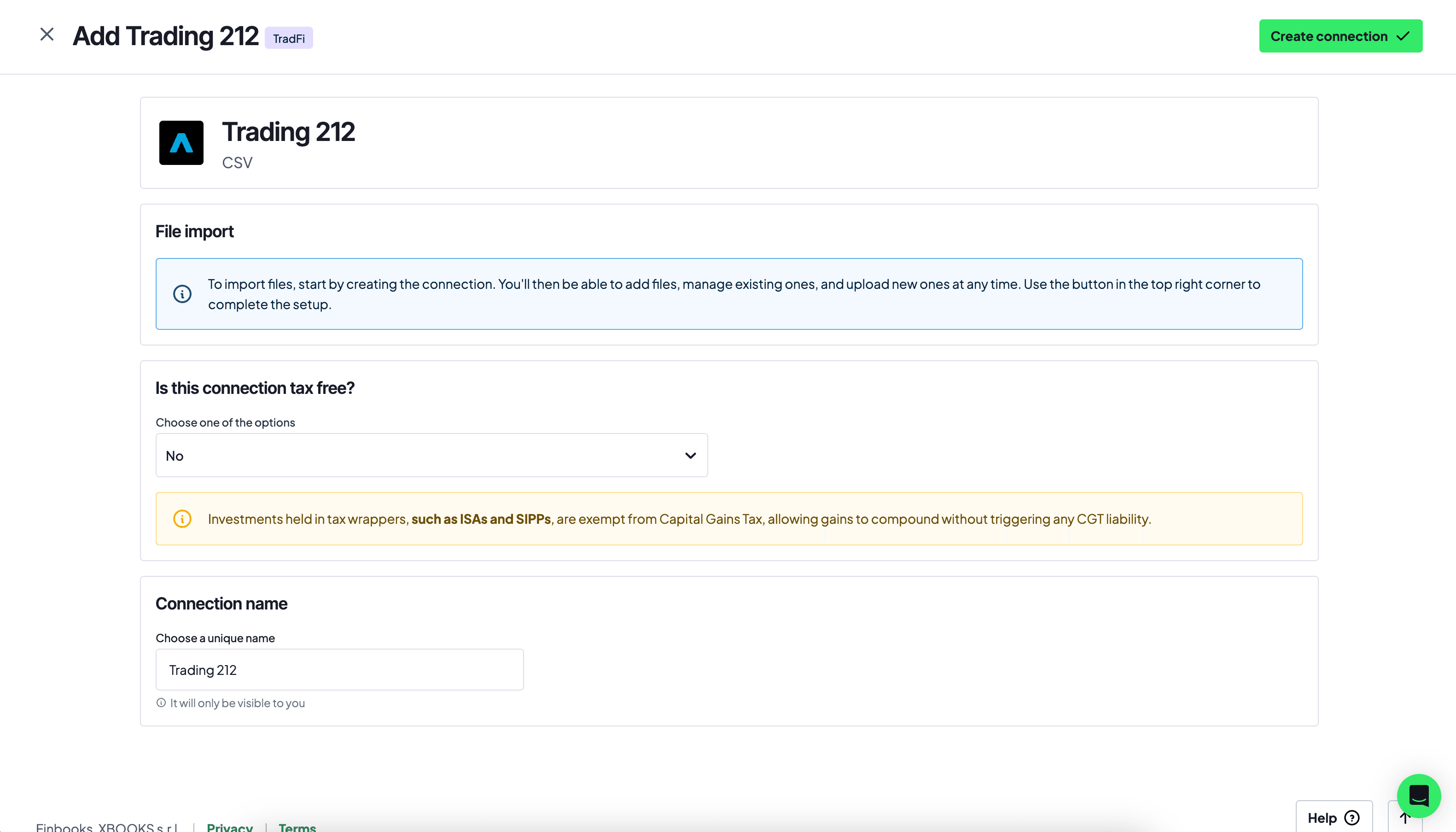
CFD exports currently cover a maximum of 12 months per file. For a longer history, generate consecutive CSVs with no gaps and upload them all to Finbooks.
Finbooks then reconstructs the imported history, separates gains from income and prepares the figures needed for your pre-filled Self Assessment.
Deadlines: when Trading 212 tax is due
The 2025/26 tax year ended on 5 April 2026. An online Self Assessment return for that year is due by 31 January 2027, and tax still outstanding is normally payable on the same date.
You may also have payments on account towards the following year, with the first due on 31 January and the second on 31 July. Trading 212 does not settle your overall UK tax liability for you, even where foreign withholding tax has been deducted from a dividend.
The practical deadline is earlier than January. Reconstructing missing acquisition history, checking foreign ETFs and separating Invest, ISA and CFD records becomes much harder when it is left until the filing deadline.
Trading 212 and HMRC compliance checks
Trading 212's records do not replace your own tax calculation. Information held by financial institutions may also be available to HMRC through domestic reporting, regulatory enquiries or international exchange arrangements, but platform reporting does not tell HMRC your complete tax position.
The common problem is inconsistency: an Invest disposal reported without the original cost, a foreign dividend entered net of withholding tax, an ISA transaction mixed into taxable activity or a CFD account result copied as one figure without reviewing its components.
Keep the underlying CSVs, statements and calculations. HMRC normally requires Self Assessment records to be retained for at least 22 months after the end of the tax year where the return is filed on time, and longer rules can apply in other circumstances. The useful record is not only the final gain; it is the evidence showing how that gain was produced.
Report Trading 212 with Finbooks
Trading 212 makes it easy to invest, receive dividends and trade different instruments from the same app. Preparing the tax position behind that activity is less straightforward. The platform export records what happened in your account, but it does not determine the final figures that belong on your UK tax return.
Finbooks closes that gap. Once you upload your Trading 212 CSVs, it reconstructs your taxable Invest and CFD history, converts foreign-currency transactions into pounds and keeps capital gains, dividends and interest in the correct tax categories. HMRC's share pooling, same-day and 30-day matching rules are applied before the figures are carried into your pre-filled Self Assessment.
The calculation becomes even more important when Trading 212 is only one part of your portfolio. HMRC's matching rules apply across all your holdings of the same asset, not separately to each broker. A sale through Trading 212 may therefore depend on shares bought through another platform, while dividends and gains from every account still need to be brought into one consistent tax position.
Instead of rebuilding that history manually in a spreadsheet, Finbooks gives you one place to review the calculation, identify missing data and prepare the information you need to file with confidence.
Try Finbooks free for 7 days and turn your Trading 212 history into Self Assessment-ready figures.
Trading 212 UK tax questions
No. Gains, dividends and interest arising inside the ISA are generally tax-free and do not normally appear on your Self Assessment.
Not always. If investments sold in 2025/26 were acquired earlier, you may need the complete history to calculate their allowable cost correctly.
No. Capital treatment is common for individual investors, but Income Tax may apply where the activity genuinely amounts to a trade or has a commercial purpose.