

Saxo is a global multi-asset broker whose UK service is provided by Saxo Capital Markets UK Ltd, an FCA-authorised company owned by Saxo Bank A/S in Denmark. One individual account can provide access to international shares and ETFs, funds, bonds, CFDs, forex, futures and listed options, with multiple currency sub-accounts available alongside the main account.
That breadth is useful for investing, but it prevents Saxo's overall performance figure from becoming a UK tax figure. A dividend from a share is income, a dividend-equivalent adjustment on a CFD belongs to the contract, interest on spare cash is savings income, and the premium or settlement of an option follows the derivative rules. The ISA can shelter eligible investments from all of those ordinary personal tax charges, while the same position in the General Investment Account remains taxable.
This guide explains how each Saxo account and product is treated, what the broker's UK tax report can and cannot tell you, which files to download and how to prepare the 2025/26 figures in Finbooks.
Do you need to report Saxo to HMRC?
Activity in Saxo's General Investment Account may need to be reported when you dispose of an investment, close or settle a derivative, receive taxable income or claim an allowable loss. The broker's UK location does not remove the need to calculate the result, and the use of foreign exchanges does not move worldwide income and gains outside a UK resident's tax position.
Investments held in the Saxo Stocks & Shares ISA are generally free from UK Income Tax and Capital Gains Tax, while ordinary dealing inside a SIPP follows the pension wrapper rather than your personal capital-gains calculation. Those accounts should remain distinct from the taxable GIA even when they contain identical securities.
Within the GIA, selling shares, ETFs or funds can produce a chargeable gain or allowable loss, dividends and fund distributions are income, and interest credited on uninvested cash is savings income. Bonds require their coupon income to be separated from any result on disposal or redemption, whose treatment depends on the security.
Saxo's CFDs, futures, options and forex positions add another layer because they are contracts with their own tax analysis rather than acquisitions of the market shown on screen. For many individual investors, ordinary retail CFDs and recognised financial futures fall within Capital Gains Tax, although a different result can apply where the activity genuinely forms part of a trade or the contract falls into another statutory category.
For 2025/26, individuals generally have a £3,000 Capital Gains Tax annual exempt amount. Gains above the available amount are normally taxed at 18% within the unused basic-rate band and at 24% above it. Where you already need to file Self Assessment, SA108 may still be required if proceeds from chargeable disposals exceeded £50,000, even when gains after losses remained below the annual exemption.
Those figures cover your combined chargeable assets rather than a separate Saxo allowance. A loss on a Saxo CFD can affect gains on shares held elsewhere, while an acquisition through another broker may change the pooled cost of a share later sold through Saxo.
Which Saxo accounts are tax-free in the UK?
Saxo offers a Flexible Stocks & Shares ISA and access to SIPPs alongside its taxable individual account. Each wrapper has its own rules and must be identified before the transactions are combined.
Saxo Flexible ISA
Eligible gains, dividends and interest arising inside the Saxo ISA are generally outside UK Capital Gains Tax and Income Tax. The 2025/26 subscription allowance was £20,000 across all your ISAs, and any unused amount expired after 5 April 2026 rather than carrying forward.
Saxo launched its Flexible ISA in April 2025, shortly after the 2025/26 tax year began. Under a flexible ISA, money withdrawn can generally be replaced within the same tax year without using additional allowance, subject to the provider's rules and correct account records. If your account or withdrawal predates the flexible version, confirm its status instead of assuming the current feature applied retrospectively.
The Saxo ISA can hold eligible shares, ETFs, funds and bonds, but it cannot hold CFDs, futures, options or forex positions. A valid ISA transfer remains inside the wrapper, whereas selling an investment in the GIA and contributing the cash to an ISA creates an external disposal before the new ISA holding is acquired.
Saxo SIPP
Investments bought and sold inside a Saxo SIPP do not normally enter the investor's personal capital-gains calculation, and investment income remains within the pension environment. Contributions, access and withdrawals follow pension rules, so the wrapper should not be treated as a second GIA merely because both accounts use the Saxo platform.
Losses inside an ISA or SIPP cannot normally reduce gains outside the wrapper. The protection works in both directions: taxable growth is sheltered, but tax relief is not available when a wrapped investment falls in value.
Is Saxo protected by the FSCS?
Saxo Capital Markets UK Ltd is authorised and regulated by the FCA under firm reference number 551422. Client money is held in trust through segregated bank accounts, while custody assets are held separately from Saxo's own property.
If Saxo or another authorised firm involved in the arrangement fails and protected investment business cannot be returned, the FSCS can cover eligible claims up to £85,000 per person, per firm. Eligible deposits have a separate limit of £120,000 per person, per authorised banking group, including other deposits held with that group.
FSCS limits do not insure the value of an investment, so a loss caused by a falling share, failed option strategy or leveraged CFD remains a market outcome rather than a compensation claim. Assets held with an overseas sub-custodian may also be subject to the legal arrangements of that jurisdiction.
Saxo's crypto ETNs make that product-level distinction particularly clear: the exchange-traded debt securities do not benefit from FSCS protection, even though they are accessed through an FCA-authorised broker and may have been eligible for an ISA during 2025/26.
An FCA-authorised account can contain products with different protection and tax outcomes. Check the wrapper and legal instrument rather than inferring either answer from the Saxo brand.

You invest. We handle the tax.

How are Saxo investments and derivatives taxed in the UK?
Saxo's product range becomes manageable for UK tax once ownership-based investments, income-producing cash and derivative contracts are separated before their results are calculated.
Shares, ETFs and funds
Selling a share, ETF or fund outside a tax wrapper can create a capital gain or allowable loss. HMRC normally matches shares of the same class using the same-day rule and acquisitions made during the following 30 days before drawing on the Section 104 pool.
If you buy a security through Interactive Brokers and later acquire or sell the same class through Saxo, the two histories may interact because the share pool follows you across brokers, even though neither platform includes the other's transactions in its profit calculation.
Distributions from investments you own remain income, with UK dividends normally entered in the dividends section of SA100 and foreign dividends generally declared gross before overseas withholding tax through SA106. Foreign Tax Credit Relief may be available for eligible tax paid abroad, but the amount withheld does not automatically equal the UK relief.
For 2025/26, dividends above the £500 allowance were taxed at 8.75% within the basic-rate band, 33.75% within the higher-rate band and 39.35% within the additional-rate band.
Offshore funds and excess reportable income
Saxo gives UK investors access to funds and ETFs domiciled across several jurisdictions. Where an offshore fund has UK reporting status, you may need to report excess reportable income even though no cash distribution appears in the account. The fund provider publishes that figure, usually after the end of its reporting period.
Reporting status also affects the disposal. Gains on reporting funds usually receive capital treatment, while a gain on a non-reporting offshore fund can be taxed as income. The specific fund and share class must be checked; neither the Saxo category nor the exchange on which the instrument trades settles the question.
Bonds and interest on cash
Bond coupons are generally savings income, although fund distributions from bond funds can follow their own rules. The capital result on selling or redeeming a bond depends on its classification: UK gilts and qualifying corporate bonds are commonly exempt from Capital Gains Tax, while non-qualifying bonds and more complex debt instruments may remain taxable.
Saxo also pays interest on eligible uninvested GBP, USD and EUR balances above £5,000 or the equivalent, with only the portion above the threshold earning interest. The daily calculation is settled monthly, and the resulting credit is savings income rather than a capital gain. For 2025/26, the Personal Savings Allowance was generally £1,000 for basic-rate taxpayers, £500 for higher-rate taxpayers and nil for additional-rate taxpayers.
Interest or financing debited because a margin account has negative Net Free Equity should not automatically be offset against positive savings income. Its treatment depends on the product and purpose that generated the cost; where it belongs to a CFD or another derivative, it may instead form part of that contractual calculation.
CFDs
A Saxo CFD provides exposure to a share, ETF, index, currency, commodity, bond or option without transferring ownership of the underlying asset. HMRC treats retail CFD outcomes as capital gains or allowable losses in almost every case where the activity is not itself a trade.
Commission, financing charges and dividend-equivalent cash adjustments feed into the CFD result when the contract closes. A payment labelled as a dividend adjustment does not go into the dividend section of SA100 because you did not own the underlying share, while a financing credit is not ordinary account interest.
Futures, options and forex
Recognised exchange-traded financial and commodity futures held by an individual investor commonly fall within Capital Gains Tax unless they form part of a trade. Cash-settled listed options generally receive capital treatment as well, but expiry, assignment and exercise can change both the timing and the asset involved.
Where an option or future settles by delivering the underlying security, the transaction may establish an acquisition or disposal of that security rather than ending with a standalone cash result. Saxo's closed-position figure should therefore be reconciled with any shares, bonds or commodities that appeared in the account through settlement.
Because Saxo offers spot pairs, forwards, options and CFD exposure, the instrument type in the Account Statement and dedicated FX reports must be identified before the tax treatment is chosen. A cash movement between currency sub-accounts is not the same event as closing a leveraged FX contract, and their results cannot be classified from the currency pair alone.
Crypto ETNs during 2025/26
Saxo does not give UK retail investors direct ownership of cryptoassets through a wallet. From 8 October 2025, it began offering eligible crypto exchange-traded notes that track assets such as bitcoin or ether, which means the investor owns a listed debt security rather than the underlying tokens.
Crypto ETNs were permitted in Stocks & Shares ISAs during the remainder of 2025/26. HMRC then confirmed that new crypto ETN purchases could no longer be made inside a Stocks & Shares ISA from 6 April 2026, although existing ISA positions could continue to be held. That date makes the account history decisive: an ETN bought inside the ISA before the cut-off remains within the wrapper, while an ETN held in the GIA requires the tax treatment of the particular security to be reviewed.
An ETN does not enter the direct-crypto pools merely because it tracks bitcoin; outside an ISA, its return follows the capital-gains or income rules applicable to the particular note and issuer. Retain the KID, ISIN and product classification with the Saxo report so that distinction can be supported.
Why is Saxo's profit figure different from your taxable result?
Saxo's portfolio report measures performance across investments and trading products, whereas Self Assessment separates ownership, income, derivatives and tax wrappers before calculating the result.
Share pooling is one source of the difference because Saxo cannot see matching acquisitions made through another broker. Foreign currency creates another: each acquisition, disposal, dividend and taxable cash flow has to be valued in pounds at the relevant date, even when the account keeps the proceeds in a USD or EUR sub-account.
Simple netting fails because a CFD dividend adjustment belongs inside the derivative gain, a genuine share dividend remains income, an exempt gain on a qualifying corporate bond does not absorb the annual exempt amount and an ISA loss cannot reduce a GIA gain. Adding those figures into one Saxo profit would discard the distinctions that determine the tax.
A Saxo portfolio report may include unrealised profit at 5 April even though Capital Gains Tax normally follows a disposal, close-out, expiry or settlement. Marking every open holding to its tax-year-end value can therefore bring amounts into the return before the relevant event has occurred.
Can you use Saxo's Dividend and Interest Tax Report for Self Assessment?
Saxo's Dividend and Interest Tax Report is a useful UK-specific income summary because it follows the UK tax year, separates UK from foreign income and converts each dividend or interest event into pounds using its value date.
The report covers income received through the General Investment Account and excludes the ISA and SIPP, where investment income is normally sheltered. It also groups foreign dividends by country and withholding-tax rate, giving you a practical starting point for SA106 and any Foreign Tax Credit Relief review.
What it cannot do is turn the entire Saxo account into a tax return. The report does not calculate gains on shares and funds, apply pooling across other brokers, determine excess reportable income, classify bond disposals or reconstruct CFDs, futures and options. Its best use is as a reconciliation against the underlying Account Statement rather than as a replacement for it.
What Saxo file do you need for Finbooks?
The primary file is the Saxo Account Statement in Excel format, downloaded for the complete account history. It records the transactions and account movements needed to reconstruct acquisitions, disposals, income, fees and derivative activity.
Use the complete history for your first import instead of restricting the report to 6 April 2025 through 5 April 2026. A sale in the year may depend on an older acquisition, a transferred position can retain its original cost, and a derivative opened before 6 April may close during the return period.
The Dividend and Interest Tax Report should be retained as a cross-check, while Saxo's dedicated Dividends, Account Interest Details, Bond coupon payments, CFD cash adjustments, CFD finance details and FX rollover reports can resolve specific reconciliation issues. You do not need to download every report automatically; begin with the Account Statement and add a specialist report only where the underlying event is unclear.
ISA and SIPP statements do not normally belong in the taxable import, but keeping them alongside the GIA records makes it possible to explain transfers and confirm which holdings were protected by a wrapper.
How to import Saxo into Finbooks
1. Log in to SaxoInvestor or SaxoTrader.
2. Open My profile.
3. Select Account activity and reports, then Account reports.
4. Choose Download report and select Account Statement.
5. Set the period from your first Saxo transaction through to the present and include all relevant GIA sub-accounts.
6. Download the report in Excel format.
7. Upload the file through the available Saxo connection in Finbooks or use a custom connection where the native format is not listed.
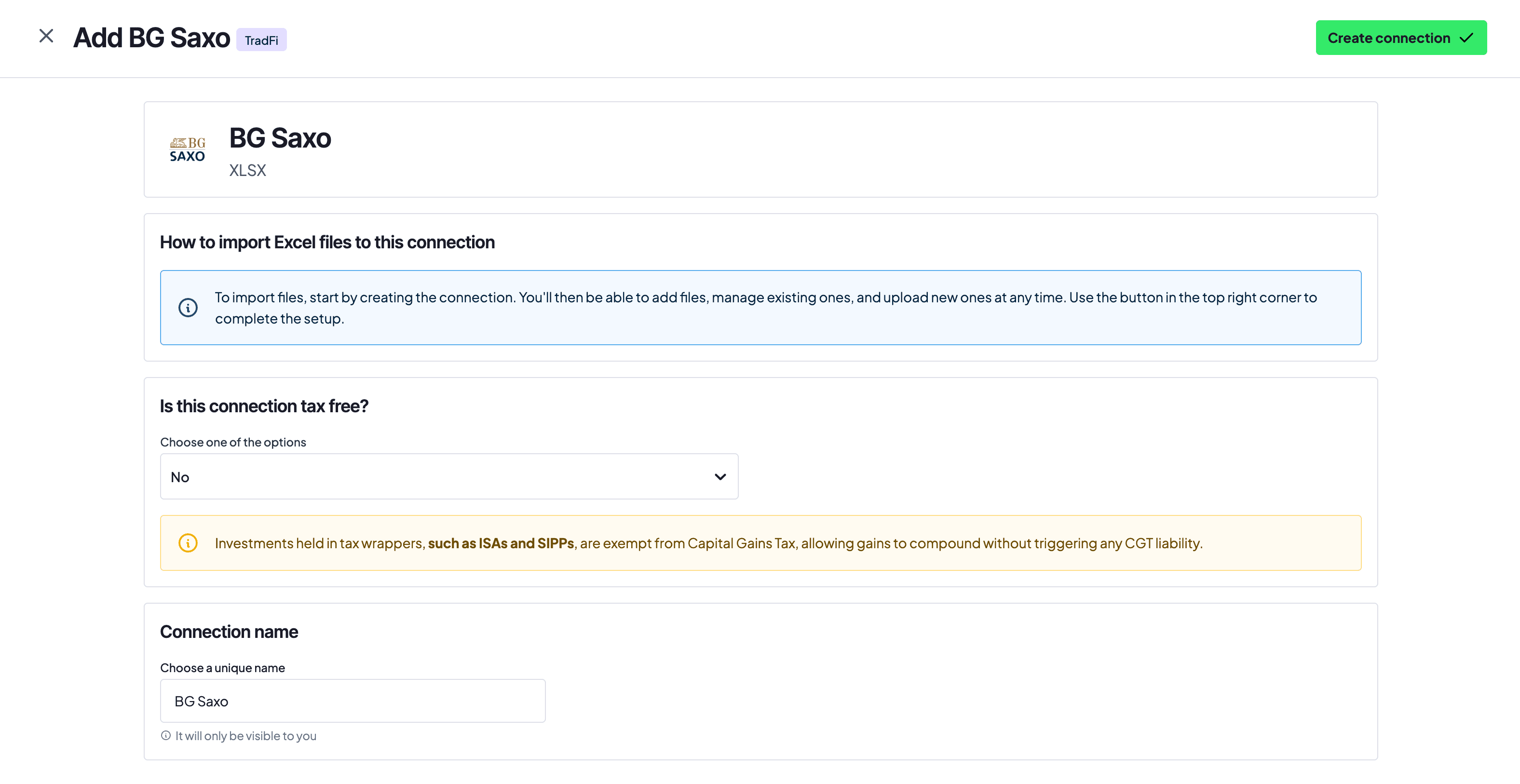
Once the history is imported, Finbooks can reconstruct the UK position across Saxo and your other brokers: share pools are maintained across account boundaries, foreign values are translated into pounds, investment income remains separate from disposal gains and derivative cash flows are assigned to the products that generated them.
Review any transferred securities whose original cost does not appear in Saxo and add the earlier broker history before finalising the return. A portfolio transfer changes custody, not the acquisition date or allowable cost of the investment.
When is Saxo tax due for 2025/26?
The 2025/26 UK tax year ran from 6 April 2025 to 5 April 2026, with the online Self Assessment return and any outstanding tax normally due by 31 January 2027.
If this is your first year within Self Assessment, you generally need to notify HMRC by 5 October 2026, while paper returns are normally due by 31 October 2026. Payments on account may also apply to some Income Tax liabilities, with instalments falling on 31 January and 31 July.
Saxo's Dividend and Interest Tax Report is generated after the end of the tax year, but there is no need to wait for it before rebuilding the transaction history. Starting with the Account Statement leaves time to resolve transferred positions, offshore-fund income and derivative settlements before the filing deadline.
What information can Saxo report to tax authorities?
Saxo collects tax residence and tax-identification information as part of account opening and ongoing compliance. Financial institutions within the Saxo group are subject to reporting frameworks such as the Common Reporting Standard where the relevant entity, customer and account fall within scope, allowing account information to be exchanged with the appropriate tax authority.
Information reported by Saxo can identify holdings, proceeds and income without reproducing the figure required on Self Assessment, because the broker cannot see matching shares held elsewhere, determine the tax status of every investment from your wider circumstances or apply your allowances and carried-forward losses.
Keep the original Excel reports, the Dividend and Interest Tax Report, evidence for transferred acquisition costs and the calculation supporting the return. Those records connect Saxo's account data to the UK tax treatment ultimately used.
Report Saxo with Finbooks
Saxo brings global investments and complex trading products into one account, but the tax calculation still has to respect the legal boundary around every holding. Shares, fund income, bond coupons, cash interest, CFDs and listed derivatives cannot be turned into one taxable profit without losing information that affects the liability.
Finbooks follows those records across Saxo and the rest of your portfolio, preserving pooled acquisition costs, allowable losses and foreign-income details while keeping wrappers and exempt products outside the taxable calculation. The completed history can then be reviewed as a single UK tax position and prepared for Self Assessment.
You retain the detail needed to explain the figures instead of relying on a portfolio return that was designed to measure performance rather than tax.
Try Finbooks free for 7 days and turn your Saxo history into Self Assessment-ready figures.