

MEXEM is an introducing broker rather than a standalone custodian. Mexem Financial Services UK Ltd is the FCA-regulated firm through which UK customers open and manage the relationship, while Interactive Brokers (UK) Ltd provides the underlying trading technology, execution, clearing and custody. MEXEM is independent from the Interactive Brokers group, but its accounts run on Interactive Brokers infrastructure.
That structure explains why MEXEM clients use tools such as Client Portal and Trader Workstation, and why the main account record is an Interactive Brokers-style Activity Statement. It also gives MEXEM users access to global shares, ETFs, bonds, options, futures and several currencies from one account.
The UK tax treatment still depends on the MEXEM account wrapper and the instrument traded. The General Investment Account sits inside the taxable regime, while the Stocks & Shares ISA protects eligible gains and income from UK tax. Foreign currencies and the range of available instruments add further calculations that the portfolio result does not show.
This guide explains which MEXEM activity needs reporting, what the Interactive Brokers relationship means for your records, which statement to download and how to import it into Finbooks to calculate tax-ready figures and generate a pre-filled Self Assessment.
Do you need to report MEXEM to HMRC?
MEXEM activity may need reporting when it takes place in a General Investment Account and produces a disposal, taxable income or an allowable loss.
Selling shares, ETFs, bonds or other investments in a MEXEM GIA can create a capital gain or loss. Dividends, bond interest and interest on cash are income rather than capital gains, so they follow separate allowances and sections of Self Assessment.
Investments held inside a MEXEM Stocks & Shares ISA are generally exempt from UK Capital Gains Tax and Income Tax. Gains, dividends and interest produced within the wrapper do not normally appear on your Self Assessment.
Buying and continuing to hold an investment does not usually trigger reporting by itself. The relevant point normally comes when you sell or otherwise dispose of an asset, receive income or claim a loss. The SA108 capital gains pages may still be required if your total disposal proceeds for 2025/26 exceeded £50,000 and you are already required to file a Self Assessment return, even where no Capital Gains Tax is due.
Does MEXEM offer a Stocks & Shares ISA?
MEXEM UK now offers a Stocks & Shares ISA for eligible UK residents. The account can hold qualifying investments, including eligible shares, ETFs, funds and bonds, while protecting returns inside the wrapper from UK Capital Gains Tax and Income Tax.
The ISA subscription limit for 2025/26 is £20,000 across all your ISAs combined. The limit applies to the amount contributed, not to the value of the portfolio or the income and gains it later produces.
The MEXEM ISA is separate from the MEXEM General Investment Account. A position shown in the same Client Portal is not tax-free unless it sits inside the ISA wrapper. Selling an investment in the GIA and buying it again in the ISA normally creates a disposal in the GIA, so the sale may still produce a taxable gain.
MEXEM describes its Stocks & Shares ISA as non-flexible. If you withdraw money and pay it back during the same tax year, the replacement contribution normally uses more of your annual ISA allowance.
How does the MEXEM and Interactive Brokers relationship work?
MEXEM Financial Services UK Ltd is authorised and regulated by the FCA under firm reference number 1009371. MEXEM acts as an introducing broker and does not itself hold the client's money or investments.
Interactive Brokers (UK) Ltd provides execution, clearing and custody for MEXEM UK accounts. The Client Portal, Trader Workstation and Activity Statement therefore use Interactive Brokers infrastructure, even though the customer relationship and support experience carry the MEXEM brand.
For tax, the practical result is straightforward: the Activity Statement is the central record of trades, dividends, interest, fees and currency movements. The Interactive Brokers technology does not change the UK tax rules, but it explains why a MEXEM statement looks similar to the statement of a direct IBKR client.
MEXEM and FSCS protection
MEXEM states that client money and investments are held with Interactive Brokers UK in segregated accounts. If Interactive Brokers UK fails and eligible assets cannot be returned, qualifying clients may be protected by the Financial Services Compensation Scheme up to £85,000.
The £85,000 limit is not protection against an investment falling in value. FSCS eligibility depends on the client, product and cause of the loss. MEXEM's ISA and GIA use the same underlying UK client-asset framework, while professional clients may have different protections from retail clients.
FSCS protection does not determine tax treatment. A GIA can be FSCS-eligible and taxable, while an ISA can be tax-free and still exposed to normal market losses.

You invest. We handle the tax.

How are MEXEM investments taxed in the UK?
The MEXEM account wrapper determines whether UK tax applies, while the instrument determines how a taxable return is classified.
Stocks & Shares ISA
Eligible gains, dividends and interest inside the MEXEM Stocks & Shares ISA are generally tax-free. ISA transactions do not normally need to be included in a Self Assessment return, and losses inside the ISA cannot be claimed against taxable gains outside it.
Shares and ETFs in a General Investment Account
Selling shares or ETFs in a MEXEM GIA can create a capital gain or allowable loss. Reportable disposals and gains go on the SA108 capital gains summary.
Shares of the same class are normally combined in a Section 104 pool across all taxable accounts held by the same beneficial owner. HMRC matches acquisitions made on the same day as a disposal first, followed by acquisitions of the same shares in the next 30 days. The remaining disposal is matched with the pooled average cost.
These rules apply across brokers. A MEXEM sale can therefore depend on shares acquired through Interactive Brokers, Trading 212 or another platform, even though those purchases do not appear in the MEXEM Activity Statement.
Dividends and foreign withholding tax
Dividends are income, not capital gains. UK dividends normally go in the dividends section of SA100. Foreign dividends, including payments from US companies, normally belong on SA106.
The dividend shown in the cash balance may be net of foreign withholding tax. A UK return generally starts from the gross dividend before withholding, with Foreign Tax Credit Relief considered separately. A valid W-8BEN can usually reduce US withholding to the treaty rate, but it does not remove the UK reporting obligation.
For 2025/26, the dividend allowance is £500. Dividends above the available allowance are taxed at 8.75% at the basic rate, 33.75% at the higher rate and 39.35% at the additional rate. The ordinary and upper rates increased from 6 April 2026, but those higher rates do not apply to the 2025/26 return.
Bonds, coupons and cash interest
Bond sales can produce capital gains or losses, while coupon payments are generally interest income. Interest paid on an uninvested MEXEM cash balance is also savings income, even where no trade was placed to earn it.
The Personal Savings Allowance for 2025/26 is normally £1,000 for basic-rate taxpayers, £500 for higher-rate taxpayers and nil for additional-rate taxpayers. Foreign interest may need to be reported on SA106 rather than in the UK interest section of SA100.
Some bonds have instrument-specific rules, including accrued income treatment. The Activity Statement records the cash movement, but it does not decide the correct UK classification for every security.
Options, futures and CFDs
Options, futures and CFDs require separate analysis because the outcome depends on the contract and what happened to it. Closing, exercising or allowing an option to expire can produce different calculations. For many individual investors, profits and losses fall within Capital Gains Tax and are reported on SA108.
Activity that genuinely amounts to a trade may instead fall within Income Tax. HMRC does not set a fixed number of trades, holding period or leverage level that automatically creates trading income. The purpose, organisation, financing and overall pattern of the activity all matter.
Offshore ETFs and reporting fund status
An offshore ETF's UK reporting fund status can change its treatment outside an ISA. A gain on a non-reporting offshore fund can be taxed as income instead of as a capital gain. A reporting fund can produce excess reportable income even where no cash distribution appears in the MEXEM account.
Check the exact fund and share class. Access through a UK-regulated broker does not prove that an overseas ETF has UK reporting fund status.
Why is MEXEM's profit figure different from your taxable gain?
The profit shown by MEXEM measures account performance. HMRC requires a sterling tax calculation for each relevant asset and income stream.
MEXEM provides access to multiple currencies, so the acquisition cost and disposal proceeds of a foreign investment must be converted into pounds at their respective transaction dates. A position that shows little movement in dollars or euros can still produce a sterling gain or loss because the exchange rate changed between purchase and sale.
The broker's displayed cost basis may also differ from HMRC's result because UK same-day, 30-day and Section 104 pooling rules apply across every taxable account. MEXEM cannot see matching acquisitions held with another broker unless that history is brought into the same calculation.
MEXEM account totals can also combine returns that belong in different parts of Self Assessment. Capital gains, dividends, bond interest, cash interest and derivative results cannot be entered as one net number. Capital losses do not reduce dividend or savings income.
Foreign currency held or converted separately from an investment can require its own analysis. Currency other than sterling can be a chargeable asset, although exemptions and special rules may apply depending on how the balance is held and used. Regularly managing non-sterling cash warrants a separate check rather than assuming every conversion is tax-neutral.
For 2025/26, individuals generally have a £3,000 Capital Gains Tax annual exempt amount. Gains above the available amount are normally taxed at 18% to the extent they fall within the unused basic-rate band and 24% above it.
What MEXEM file do you need for Finbooks?
Finbooks needs the MEXEM Activity Statement in CSV format for each taxable General Investment Account. Select the complete available history so the file includes trades, dividends, interest, fees and currency activity.
You do not need to import the MEXEM Stocks & Shares ISA because gains and income inside the wrapper are excluded from the taxable calculation. If the Client Portal displays more than one account, select the GIA account number before generating the statement.
Download the full history for the first import rather than only 2025/26. A sale made during the tax year can depend on an acquisition from an earlier year, and a tax-year-only statement may omit the original pooled cost.
How to import MEXEM into Finbooks
1. Log in to the MEXEM Client Portal.
2. Open Reports, then select Statements.
3. Choose Activity from the available statements.
4. Select the taxable GIA and set the period from your first transaction through to today.
5. Choose CSV as the format and run the statement.
6. Upload the CSV to Finbooks by creating a MEXEM connection or updating an existing one.
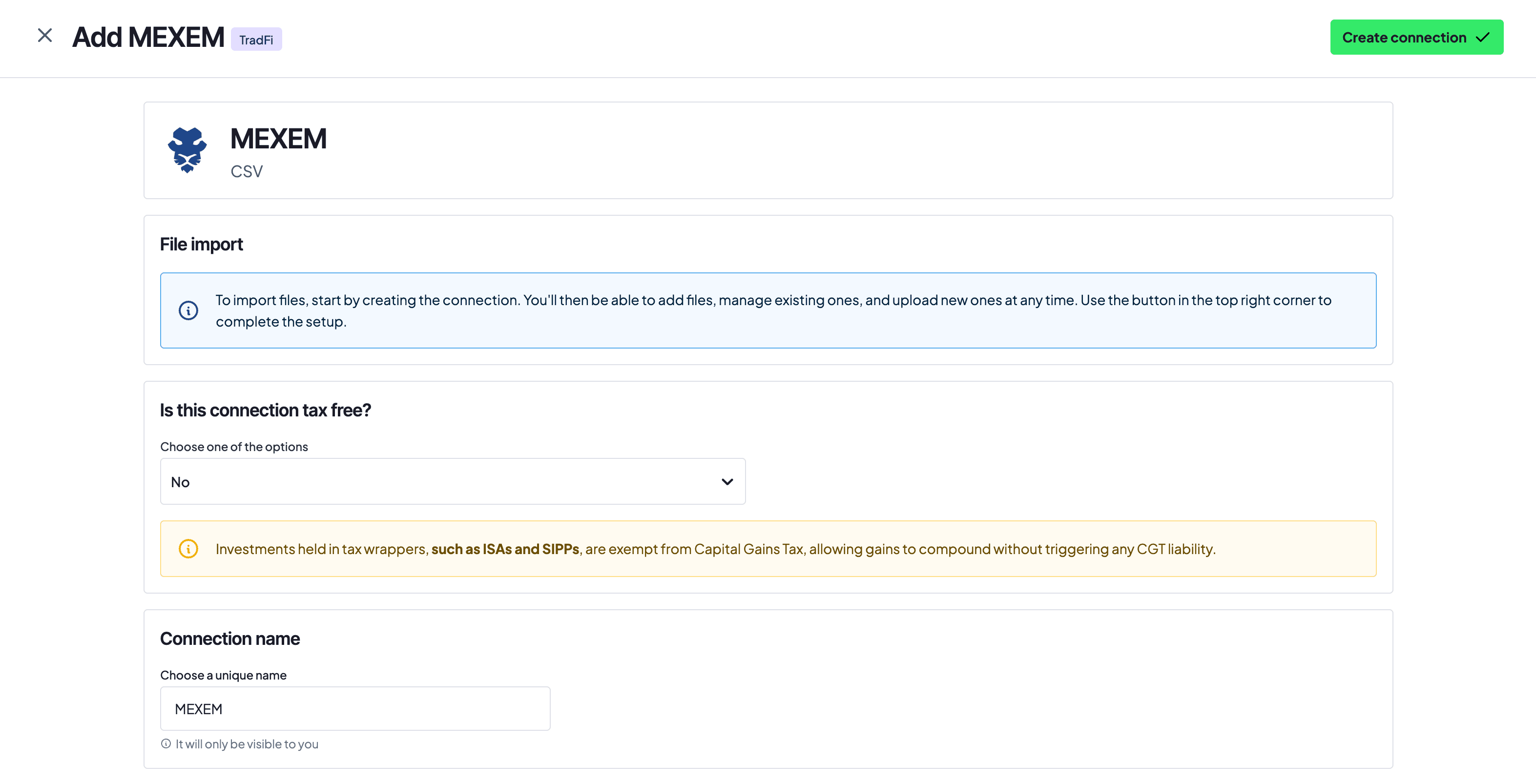
If MEXEM cannot produce one statement for the complete period, download consecutive CSV files with no gaps and upload them all. Finbooks then reconstructs the taxable history, converts foreign-currency transactions into pounds and applies HMRC's pooling and matching rules before preparing the figures for your pre-filled Self Assessment.
When is MEXEM tax due for 2025/26?
The 2025/26 tax year ran from 6 April 2025 to 5 April 2026. The online Self Assessment return and any outstanding tax are normally due by 31 January 2027.
If you need to file for the first time, you generally need to tell HMRC by 5 October 2026. A paper return is normally due by 31 October 2026. Payments on account may also apply to some Income Tax liabilities, with instalments due on 31 January and 31 July.
The MEXEM Activity Statement can be generated before the filing deadline. Downloading it early leaves time to find older acquisition costs, confirm foreign withholding tax and identify any matching purchases held with another broker.
MEXEM and HMRC compliance checks
The Activity Statement is the best record of what happened inside the MEXEM account, but it is not a completed UK tax return. Financial institutions may report specified customer and account information under domestic rules, regulatory requests or international exchange arrangements, while HMRC can compare that information with a Self Assessment return.
The most common risk is an incomplete calculation rather than a missing statement. A return may include the net MEXEM profit but omit foreign dividends, use a dollar cost basis without transaction-date conversion or ignore shares of the same class held through another broker.
Keep the CSV statements, evidence of transfers and the calculation supporting the return. The final gain alone is not enough; the supporting history should show how each sterling amount and tax category was produced.
Report MEXEM with Finbooks
MEXEM combines global market access with Interactive Brokers technology, but the Activity Statement still needs to be translated into UK tax rules. One account can contain pooled share disposals, foreign dividends, bond income, derivative results and several currencies, each with a different place in the calculation.
Finbooks turns the MEXEM Activity Statement into one consistent UK tax record. It converts transactions into pounds, applies HMRC's share matching rules and keeps capital gains separate from dividends and interest before preparing the figures for Self Assessment.
The calculation becomes more important when MEXEM is only one part of the portfolio. HMRC pooling applies across holdings of the same asset, not separately to each broker. Finbooks can bring the MEXEM history together with other platforms instead of treating every statement as an isolated tax position.
You can review the imported history, resolve missing data and move from the broker statement to a pre-filled Self Assessment without rebuilding every trade and currency conversion in a spreadsheet.
Try Finbooks free for 7 days and turn your MEXEM history into Self Assessment-ready figures.