

Interactive Brokers is built for investors who want direct access to global markets: shares, ETFs, options, futures and bonds across dozens of exchanges, often in the asset's native currency. That flexibility is exactly why IBKR reporting tends to be more involved than a simpler UK app. More instruments, more currencies, and a broker structure that spans several legal entities.
This guide covers what needs reporting from an IBKR account, why the platform's own profit figure isn't the one HMRC wants, which export to download, and how to bring it into Finbooks.
What you need to know for 2025/26
Most ordinary IBKR activity sits in a taxable account rather than an ISA, unless a separate pension or other tax wrapper applies.
The P&L displayed by IBKR is not a UK tax calculation: GBP conversion, Section 104 pooling and the same-day and 30-day rules can all change the result.
Capital gains, dividends, interest, bond coupons, derivatives and currency activity do not all follow the same reporting route.
The Activity Statement in CSV format is the central source for reconstructing trades, income, withholding tax and multi-currency movements.
Do you need to report Interactive Brokers to HMRC?
In almost all cases, yes. If you've bought, sold or held income-generating assets through IBKR during the tax year.
IBKR UK doesn't offer an ISA wrapper. Unless you're trading through a SIPP linked to your IBKR account, or the account is structured as a pension wrapper by a third party, your activity sits in a standard taxable account by default. That's a meaningful difference from apps like Trading 212, where a large share of retail activity happens inside a tax-free ISA. With IBKR, most of it doesn't.
So the starting position is simple: assume everything is reportable, then work out which instruments follow rules other than a plain "buy low, sell high" capital gain. On IBKR, that's more of them than you might expect.
Interactive Brokers and FSCS protection
Interactive Brokers (U.K.) Limited is regulated by the FCA, but an IBKR account may involve several linked entities, including Interactive Brokers LLC in the United States and Interactive Brokers Ireland.
Do not assume every IBKR position has the same protection
The applicable protection scheme may depend on the entity holding or executing the position. UK FSCS, US SIPC or another jurisdiction’s arrangements may apply in different circumstances; the UK scheme does not automatically cover the entire account.
The same structure matters for reporting. “My IBKR account” is not always one legal relationship, which is why the Activity Statement is more useful than the dashboard balance when reconstructing the tax position.
Why the IBKR P&L figure isn't your taxable gain
IBKR's profit and loss report is genuinely useful for reading how your portfolio is performing. It is not the number that goes on your return, and the gap between the two is usually wider than people expect. Three things drive it.
The first is currency: most UK investing apps show you everything in GBP. IBKR often doesn't — you can hold USD, EUR or other balances directly and buy US shares in USD. For UK tax, the cost of an asset and the proceeds when you sell it both need converting to GBP at the rate applying on their own transaction dates, months or years apart. A position that looks flat in dollars can produce a real gain in sterling, or the reverse, purely because the exchange rate moved between the two legs.
The second is how cost basis is calculated: HMRC doesn't use FIFO or the average cost your broker displays. Shares of the same class in the same company go into a Section 104 holding, a single pool with a weighted-average cost that shifts every time you buy more. On top of that sit the same-day rule and the 30-day rule, which override the pool when you sell and repurchase the same asset within a short window. IBKR has no reason to apply any of this, because it isn't a UK tax calculation engine.
The third is instrument classification: a single P&L line can contain things that don't share a tax treatment. Shares, ETFs, bonds, options, futures, dividends, coupons and interest on cash follow different rules, and they can't all be netted off against each other the way an aggregate performance figure implies.
Performance and taxable profit answer different questions
IBKR measures what happened inside the brokerage account. HMRC requires a sterling tax calculation that can also depend on matching transactions and holdings outside IBKR.
What to report from your Interactive Brokers account
Once you've separated the account by what you actually did with it, the usual reporting routes become clearer.
| IBKR activity | What matters for UK tax | Where it is usually reported |
|---|---|---|
| Share disposals | Capital gain or allowable loss calculated in GBP after HMRC pooling and matching. | SA108 where reporting is required. |
| ETF disposals | Capital treatment usually depends on the fund having UK reporting-fund status; non-reporting funds can produce offshore income gains. | SA108 or the relevant income pages, depending on fund status. |
| UK dividends | Dividend income, kept separate from capital gains and losses. | The dividends section of SA100. |
| Foreign dividends | Declared gross before overseas withholding tax, with Foreign Tax Credit Relief considered separately. | Usually SA106. |
| Cash interest and bond coupons | Savings or foreign income rather than capital gains; the precise treatment can depend on the instrument and source. | SA100 or SA106, as applicable. |
| Options and futures | Treatment depends on the contract, how it ended and whether the activity is investment or trade. | Commonly SA108 for retail investment activity, or the relevant income pages where another treatment applies. |
| Standalone currency conversions | A separate chargeable gain or loss may arise depending on how the currency was held and why it was converted. | SA108 where the conversion is chargeable. |
These are the usual routes, not a substitute for reviewing the underlying instrument. The same IBKR statement can contain capital disposals, dividend income, savings income, foreign income and contracts requiring their own analysis.
Options and futures are the least predictable line on that list. Treatment turns on the instrument and on what actually happened to the contract (closed out, exercised, or left to expire) and on whether your activity reads as investment or as something closer to trading. Most retail positions still land on SA108, but this is the corner of an IBKR account where an accountant earns their fee.
Currency is the part investors most often assume is invisible. The exchange-rate effect on an investment is already baked into your GBP gain, since both legs get converted on their own dates. What's less settled is whether converting currency on its own, with no trade attached, counts as a separate chargeable event, it depends on how the balance is held, and the rules are less intuitive than they look. Convert once when you open the account and it's unlikely to matter. Convert routinely and it's worth confirming your position rather than assuming it.
A £50,000 threshold then applies regardless of what you traded: cross that much in total disposal proceeds during the tax year and you have to report on SA108 even with no overall gain. On a multi-currency account with real turnover, £50,000 of proceeds arrives faster than most people expect.
If you've only ever bought and sold plain shares or ETFs and converted currency once when you opened the account, your figures will look a lot like a standard general investment account. Active users of options, futures or frequent currency conversion should expect considerably more line items.
Options and futures cannot all be treated as one P&L line
The result can depend on the contract and whether it was closed out, exercised or allowed to expire. Most ordinary retail positions may fall within capital gains, but material or business-like activity should be reviewed on its facts.
Currency deserves the same care. The exchange-rate movement embedded in a foreign investment is already reflected when its acquisition and disposal are translated separately into GBP. Converting a currency balance independently may create an additional event, depending on how the balance was held and the purpose of the conversion.
If total disposal proceeds for 2025/26 exceeded £50,000 and you are already required to file Self Assessment, SA108 may be required even where there was no overall chargeable gain. On an actively traded multi-currency account, that proceeds threshold can be reached more quickly than expected.
US dividends, withholding tax and foreign tax credit relief
Dividends from US shares usually arrive with US withholding tax already deducted, typically at a reduced treaty rate once you've completed a W-8BEN form with IBKR.
The net figure credited to your account isn't the figure HMRC wants. You declare the gross dividend on your UK return, then claim Foreign Tax Credit Relief for the US tax already withheld, so the same income isn't taxed twice. To do that you need the gross amount, the tax withheld, the currency, and the date it was credited, all of which sit in the Activity Statement rather than in the balance you see on screen.
Dividends and interest don't offset your capital losses
This one costs people money every year. If you realise £1,000 of capital losses and receive £1,000 in dividends over the same tax year, your taxable position is not zero.
Capital losses reduce capital gains. They don't reduce dividend income, and they don't reduce interest. Each stream has its own allowance: £3,000 for gains, £500 for dividends, and the Personal Savings Allowance for interest, which varies with your income tax band and disappears entirely for additional-rate taxpayers.
That last one catches IBKR users in particular, because interest paid on uninvested cash balances is taxable savings income even though you never placed a trade to earn it. The same applies to bond coupons.
ETFs: why reporting fund status matters
If you hold ETFs domiciled outside the UK, check whether they have UK reporting fund status. It changes the answer more than most people realise.
Gains on a fund without that status can be taxed as income at your income tax rate rather than as a capital gain at 18% or 24%, and they don't benefit from the £3,000 annual exempt amount. Reporting funds bring their own wrinkle in the opposite direction: you may need to declare excess reportable income even in a year when you received no distribution and sold nothing.
HMRC publishes the list of approved reporting funds. Because IBKR gives you access to a far wider universe of ETFs than a typical UK app, this is a check worth doing before you file rather than after.
What data you need to report Interactive Brokers
Your Activity Statement covering the full tax year, and ideally your full account history; this is the single file that ties trades, dividends, interest, corporate actions and currency conversions together;
Confirmation of any withholding tax already deducted, which appears within the Activity Statement itself;
A record of which currencies you held and converted, if you actively manage a multi-currency balance;
Statements for any linked accounts, if you hold IBKR access through more than one entity — particularly relevant if you came to IBKR via an introducing broker.
Your full history matters more than the tax year alone. The cost basis of anything you sold this year depends on purchases made earlier, sometimes much earlier, and a Section 104 pool can't be reconstructed from a partial record.
How to import Interactive Brokers into Finbooks
- 1
Log in to IBKR Client Portal;
- 2
go to Performance & Reports, then Reports;
- 3
select Activity Statement;
- 4
set the period from your first transaction on the account through to today;
- 5
if you run multiple sub-accounts, select Consolidated Summary;
- 6
set the format to CSV rather than PDF;
- 7
generate the statement and upload it to your Interactive Brokers connection in Finbooks.
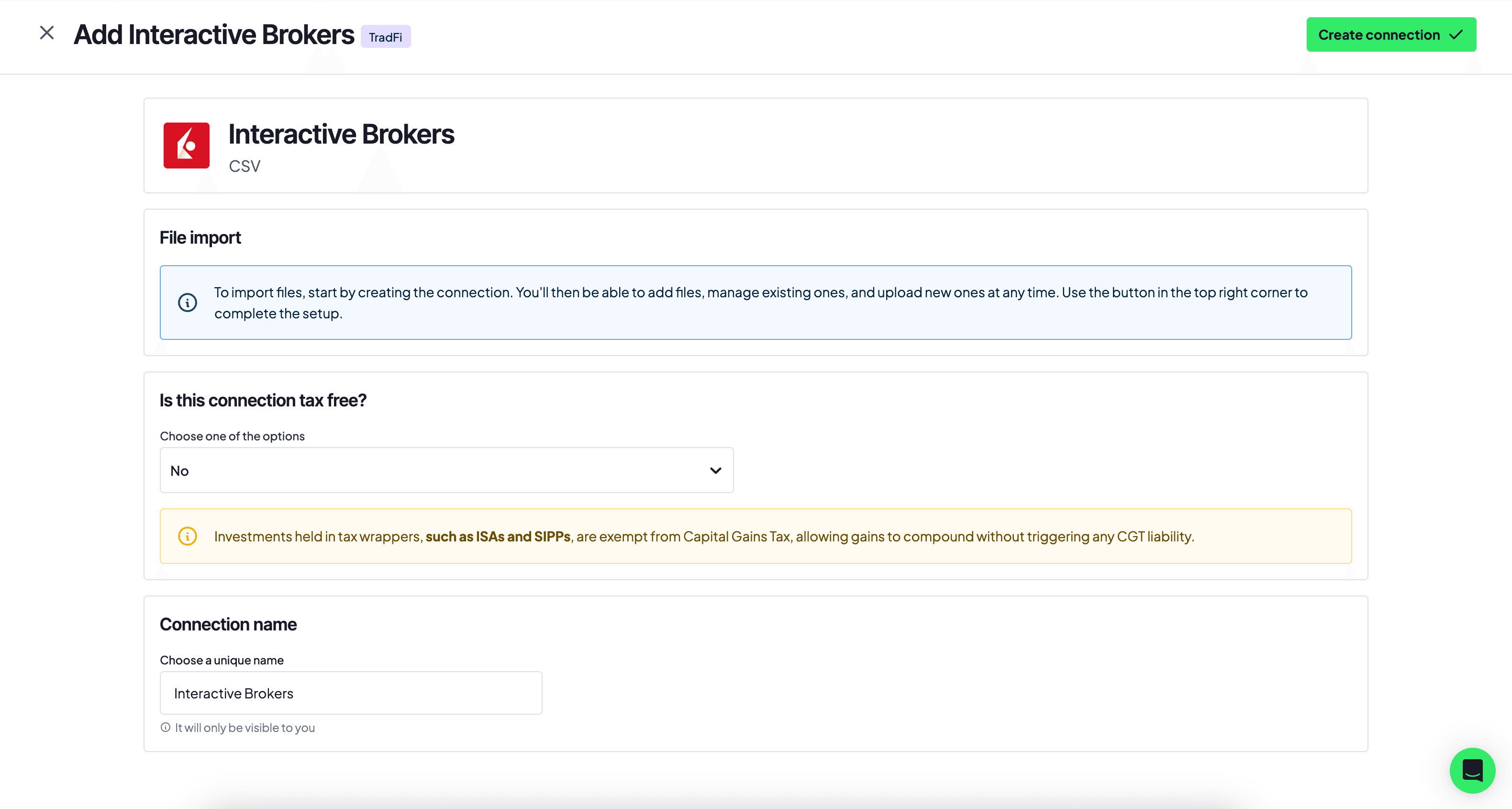
If IBKR won't generate a single file for the whole period, several CSVs work fine as long as together they cover the timeline with no gaps. Upload them to Finbooks by creating a new Interactive Brokers connection or updating an existing one, and Finbooks reconstructs your positions across currencies and instruments into the figures your Self Assessment needs.
Deadlines: when the tax is actually due
For the 2025/26 tax year, which ended on 5 April 2026, an online return is due by 31 January 2027, and that's also the date any tax owed has to be paid.
If your bill is large enough, you may also owe payments on account towards the following year, the first alongside your January balancing payment, the second by 31 July. Interactive Brokers doesn't withhold UK tax on your behalf, so nothing is settled until you settle it.
The practical implication is about timing rather than the dates themselves. Reconstructing a multi-currency Activity Statement is not a January job!
Interactive Brokers and HMRC compliance checks
Because IBKR activity often spans multiple currencies, exchanges and instrument types, the practical risk usually isn't about hiding anything. It's about the numbers not reconciling cleanly.
A return showing share disposals but ignoring currency activity, or applying a single treatment to every option position regardless of how it was used, is the kind of inconsistency that becomes hard to defend if it's ever queried. Keep the Activity Statement rather than your own notes: it's the document that shows how a figure was arrived at, trade by trade and currency by currency, which matters more with IBKR than with simpler single-currency platforms.
Report Interactive Brokers with Finbooks
Interactive Brokers gives you a genuinely comprehensive Activity Statement. What it doesn't give you is a Self Assessment.
Finbooks turns that record into an organised, defensible tax position: multi-currency activity reconciled, HMRC's pooling and matching rules applied, instruments classified, income kept apart from gains.
And that gap widens when IBKR isn't your only platform. If your portfolio is spread across brokers, exchanges and wallets, the vast majority of your work isn't calculating one account's figures, it's holding a consistent history across all of them and keeping control of your tax position instead of discovering it in January.
Try Finbooks free for 7 days and turn your Activity Statement into Self Assessment-ready figures.
Interactive Brokers UK tax questions
No. The UK calculation must apply sterling conversion, HMRC’s matching rules and the correct treatment for each instrument and income stream.
Not always. Earlier purchases may still be required to reconstruct the Section 104 cost of assets sold during the year.
Download the Activity Statement in CSV format, covering the complete available history and all relevant linked or sub-accounts.