

IG is a UK trading and investment platform with several regulated entities and account types sitting behind the same login. Through IG, you can own shares and ETFs, invest inside a Stocks & Shares ISA, speculate through CFDs or financial spread bets and, since June 2025, buy and hold cryptoassets through a dedicated account.
Those products may track the same market without creating the same tax event. Owning a company share can produce a capital gain and genuine dividend income; a share CFD produces a contractual result whose financing and dividend adjustments feed into the derivative calculation; a spread bet generally creates neither a chargeable gain nor an allowable loss; and spot bitcoin follows HMRC's crypto pooling rules.
This guide explains which IG activity needs reporting, how to distinguish the account types, what the arrival of IG Crypto means for 2025/26 and which files to import into Finbooks to calculate Self Assessment-ready figures.
Do you need to report IG to HMRC?
Whether IG needs to appear in your Self Assessment depends first on the account you used and then on the activity inside it.
Investments held inside an IG Stocks & Shares ISA are generally outside UK Income Tax and Capital Gains Tax. Gains, dividends and interest produced within the wrapper do not normally need to be included in your tax return.
Outside the ISA wrapper, selling shares, ETFs or investment trusts through an ordinary IG dealing account can create a chargeable gain or allowable loss, while dividends and interest remain separate forms of income. The same account can therefore feed more than one part of Self Assessment.
Because CFDs are contracts rather than ownership of the market they track, an individual investor's result will commonly fall within Capital Gains Tax unless the wider activity amounts to a trade. IG spread bets normally receive a different result: where the contract is genuinely a wager, there is no chargeable disposal and the winnings or losses remain outside the capital gains calculation.
The separate IG Crypto account holds spot cryptoassets rather than crypto CFDs, so selling for pounds, exchanging one token for another, spending crypto or giving it to anyone other than a spouse or civil partner can create a disposal. Buying and continuing to hold a cryptoasset does not normally need reporting on its own.
For 2025/26, individuals generally have a £3,000 Capital Gains Tax annual exempt amount. Gains above the available amount are normally taxed at 18% to the extent they fall within the unused basic-rate band and at 24% above it. If you already need to file Self Assessment, the SA108 capital gains pages may still be required when total proceeds from chargeable disposals exceeded £50,000, even where no Capital Gains Tax is payable.
Both thresholds apply to your combined chargeable disposals, not to each IG account separately. Spread bets that fall outside Capital Gains Tax do not use the £3,000 exemption or enter the £50,000 proceeds test, while share, CFD and crypto gains must be brought together with taxable gains and losses from the rest of your portfolio.
Does IG offer a Stocks & Shares ISA?
IG offers a Stocks & Shares ISA for eligible investments including shares, ETFs and investment trusts. Gains and income arising within the ISA are generally free from UK Capital Gains Tax and Income Tax.
The ISA subscription allowance for 2025/26 was £20,000 across all your ISAs combined. The limit applied to money contributed during the tax year, not to the value of the investments or the growth achieved inside the account.
An IG ISA is distinct from the IG share dealing account even when both contain the same security. Shares cannot normally be moved directly from the taxable account into the ISA. IG's Bed and ISA service sells eligible UK-listed shares and repurchases them inside the wrapper, which means the external-account sale remains a disposal for Capital Gains Tax and the cash subscribed uses ISA allowance.
Direct cryptoassets, CFDs and spread bets do not become tax-free because another IG account is an ISA. An eligible listed product that provides crypto-related exposure may be held within a wrapper where the ISA rules allow it, but its treatment follows that listed product rather than direct ownership of bitcoin or another token.
Is IG protected by the FSCS?
IG's regulated UK investment and trading businesses hold client money and custody assets separately under FCA rules. If an authorised IG firm fails and eligible money or investments cannot be returned, the Financial Services Compensation Scheme may cover a shortfall up to £85,000 per eligible person.
Where cash is placed with a partner bank, deposit protection can instead cover up to £120,000 per eligible person, per banking group, including any other money you hold directly with the same group. The applicable protection depends on where the cash was held and the nature of the failure, not simply on the balance displayed in My IG.
Although IG Digital Assets Ltd is registered with the FCA as a cryptoasset service provider, the cryptoassets it offers are not specified investments protected by the FSCS. Cash used to fund or receive proceeds from the crypto account may sit in another regulated IG account, yet the cryptoassets themselves remain outside FSCS protection.
An IG spread bet can be offered by an FCA-authorised firm while remaining outside Capital Gains Tax, whereas a spot cryptoasset can be taxable even though FSCS does not protect it; protection and tax status answer different questions.
FSCS protection follows the firm, asset and type of failure. It does not cover market losses and it does not determine whether an IG transaction belongs on your tax return.

You invest. We handle the tax.

How are IG shares, CFDs, spread bets and crypto taxed in the UK?
The account label provides the starting point because the same market can be owned, traded through a derivative or used as the subject of a wager.
Stocks & Shares ISA
Eligible gains, dividends and interest inside the IG ISA are generally exempt from UK Capital Gains Tax and Income Tax. ISA disposals do not normally appear on SA108, and losses inside the wrapper cannot be claimed against gains made elsewhere.
Share dealing account
Selling shares, ETFs or investment trusts outside the ISA can create a capital gain or allowable loss. Shares of the same class are normally subject to HMRC's same-day rule, 30-day rule and Section 104 pooling, so the gain is not necessarily the difference between the sale price and the cost shown beside one IG lot.
Dividends from shares you own are investment income rather than part of the disposal gain. UK dividends normally go in the dividends section of SA100. Foreign dividends are generally reported gross before overseas withholding tax, commonly through SA106, with Foreign Tax Credit Relief considered separately where available.
For 2025/26, dividends above the £500 allowance were taxed at 8.75% within the basic-rate band, 33.75% within the higher-rate band and 39.35% within the additional-rate band.
CFD account
An IG CFD gives you a contractual exposure to a share, index, currency, commodity, bond, option or another market without transferring ownership of the underlying asset. Retail CFD outcomes are, in almost every non-trading case, charged under Capital Gains Tax.
For HMRC, commission, financing debits or credits and sums described by the platform as dividend adjustments are brought into the CFD gain or loss when the contract closes. A credit linked to a company's dividend is not a dividend received from that company, and a financing credit is not ordinary savings interest.
An allowable CFD loss can reduce chargeable gains from other assets, subject to the capital-loss rules. If the organisation, purpose and wider facts show that CFD activity genuinely forms part of a trade, Income Tax may apply instead, but frequency or leverage alone does not settle that question.
Spread-betting account
An IG spread bet is a wager on the movement of a market, quoted as an amount per point. HMRC's capital gains guidance states that no asset is acquired or disposed of through an ordinary financial spread bet, so the winnings do not create chargeable gains and the losses are not allowable.
The ordinary exemption can fall away where a spread bet serves a commercial purpose, such as hedging a business exposure, or forms part of a genuine trade. Profitability, frequency or reliance on the winnings does not by itself turn every wager into taxable trading income; the contract and the activity must be considered on their facts.
Dividend and financing adjustments inside a spread-betting account follow the bet rather than becoming separate investment income or deductible capital costs. Since the bet sits outside the capital gains regime, its losses cannot be moved into the CFD or share calculation.
IG Crypto account
IG launched its UK spot-crypto service on 2 June 2025, initially through infrastructure provided by Uphold, and later began moving customers to IG's own registered crypto service after obtaining FCA registration in September 2025. Both stages fell inside the 2025/26 tax year.
A sale of spot crypto for pounds is a disposal under HMRC's cryptoasset rules, and each token type normally has its own Section 104 pool with same-day and 30-day matching applied before the pooled average cost. That pool follows you across every exchange and wallet rather than stopping at the holdings visible in IG.
IG introduced direct crypto-to-crypto swaps in May 2026, after the 2025/26 tax year had ended. Any swap made later remains a disposal under UK rules, but it should not be pulled backwards into the return due on 31 January 2027. For 2025/26, the records may instead include purchases, sales and the operational migration between Uphold-supported and IG-operated infrastructure.
An operational migration does not create a disposal merely because the service provider changed. If beneficial ownership continued and the same tokens moved without being sold or exchanged, the history should be linked as a transfer. Any actual sale, conversion or disposal during that process retains its ordinary tax treatment.
Why is IG's profit figure different from your taxable result?
IG reports account performance inside separate products; HMRC requires one UK tax calculation that preserves the distinctions between those products.
A share dealing profit cannot be calculated from the IG trade alone when shares of the same class were acquired through another broker. HMRC's same-day, 30-day and Section 104 rules apply across your personal holdings, and the same cross-platform principle governs cryptoasset pools.
CFDs create a different mismatch because their taxable result includes contractual financing, commission and dividend-equivalent adjustments when the position closes. Reporting those credits again as interest or dividends would count the same economic amount in the wrong category, while ignoring the associated debits can overstate the gain.
Spread-betting performance must then be removed from the chargeable calculation altogether where the wagers fall within the ordinary exemption. Netting an IG spread-betting loss against an IG CFD gain may look reasonable on a combined dashboard, but it would claim relief that the tax rules do not provide.
Foreign currency can alter the result once more. Purchases, dividends, CFD cash flows and sales denominated in dollars or euros must be translated into pounds at the relevant dates. Converting IG's final foreign-currency profit at one year-end rate does not reproduce the sterling gain required for Self Assessment.
ETFs and UK reporting fund status
An offshore ETF held in the IG share dealing account can produce consequences beyond the cash distributions and sale shown in the ledger. If the specific fund and share class has UK reporting fund status, excess reportable income may arise even where no cash payment reaches the account. A gain on a non-reporting offshore fund can be taxed as income rather than as a capital gain.
The IG ISA normally shelters eligible fund income and gains, but the same ETF held in the taxable dealing account needs its reporting status checked. The product label alone does not answer that question.
What IG files do you need for Finbooks?
For IG share dealing and CFD activity, Finbooks needs the account ledger summary in CSV format for each taxable account. IG does not provide a capital-gains statement for share dealing accounts, and the PDF monthly or annual statement is not a substitute for the transaction-level CSV.
Download the complete history for the first import rather than limiting the file to 2025/26. A share sold during the year may depend on an acquisition made years earlier, while an open CFD can carry fees across the tax-year boundary before it closes.
IG also provides a Consolidated Tax Certificate when a share dealing account received dividends. The certificate is useful for reconciling dividend and withholding-tax totals, but it does not calculate capital gains and it is not the native file Finbooks uses for the transaction import.
You do not normally need to import the IG ISA or ordinary spread-betting account into the taxable calculation. Keep their statements so that transfers and account boundaries can be explained, particularly where cash or investments moved between taxable and wrapped accounts.
Keep IG Crypto separate from the TradFi CSV import because IG currently provides daily crypto statements and an immediately available activity history rather than the same comprehensive ledger used for shares and CFDs. Preserve the earlier Uphold-supported period and the migration to IG Digital Assets, then add the full crypto activity to Finbooks through the available crypto or custom connection instead of presenting it as share or CFD data.
How to import IG into Finbooks
1. Log in to My IG on the web.
2. Open Live Accounts and select the taxable share dealing or CFD account.
3. Go to History, then Transactions.
4. Set Type to All and choose a custom period from the account's first transaction through to today.
5. Select Show History and download the ledger in CSV format.
6. Repeat the export for every taxable IG share dealing or CFD account.
7. Upload each native CSV to Finbooks by creating an IG connection or updating the existing one.
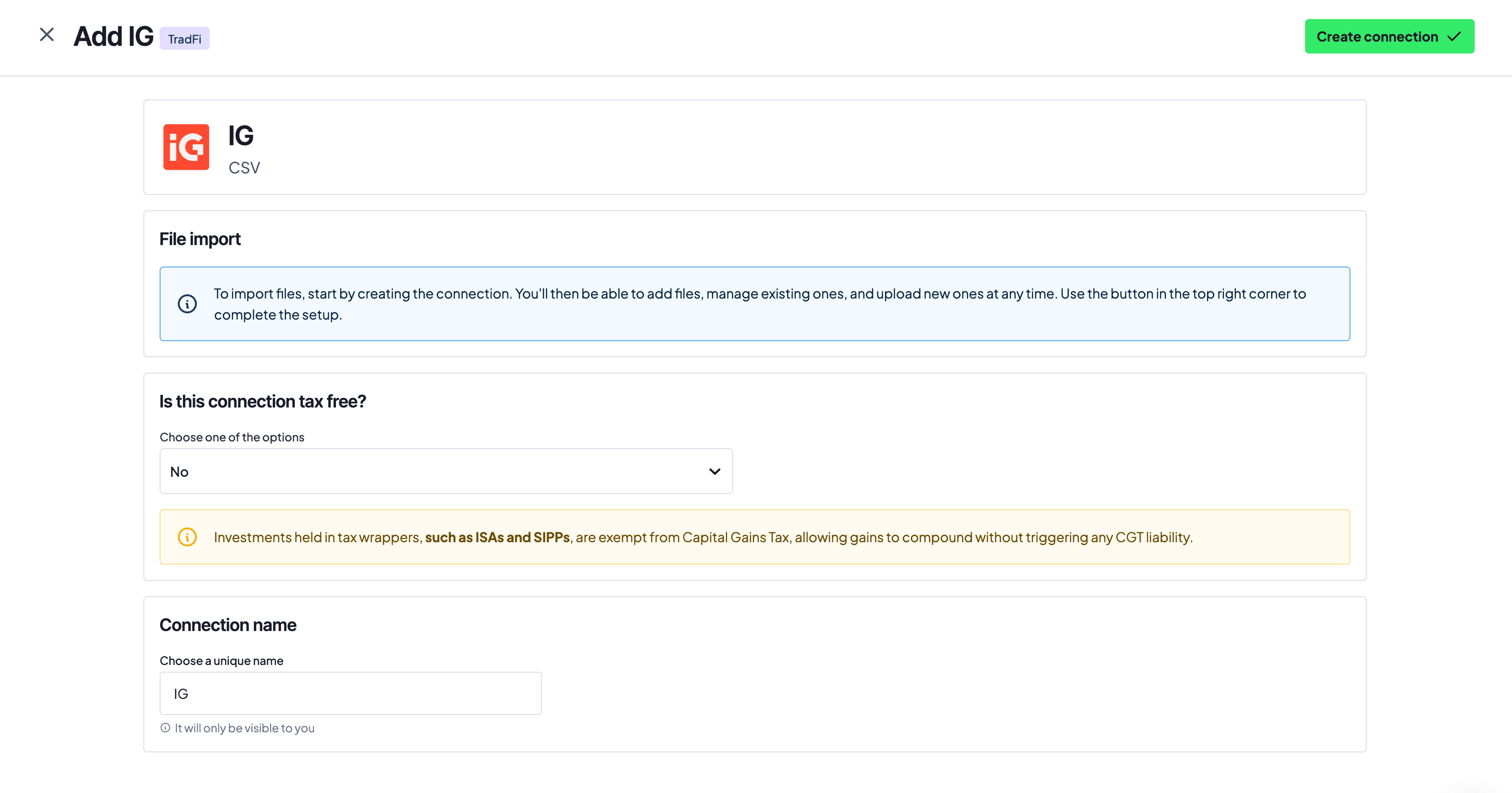
Finbooks reconstructs the taxable activity behind the IG ledgers, applying UK share matching across imported brokers, incorporating CFD cash flows into the appropriate positions, converting relevant foreign-currency amounts into pounds and keeping dividends apart from capital gains.
For IG Crypto, collect the activity history and statements from the crypto account separately. If crypto moved between IG, Uphold or another wallet or exchange, include each side of the movement so that Finbooks can preserve the token pool and distinguish a transfer from a disposal.
When is IG tax due for 2025/26?
The 2025/26 UK tax year ran from 6 April 2025 to 5 April 2026. Your online Self Assessment return and any outstanding tax are normally due by 31 January 2027.
If you need to file for the first time, you generally need to notify HMRC by 5 October 2026. A paper return is normally due by 31 October 2026. Payments on account may also apply to some Income Tax liabilities, with instalments due on 31 January and 31 July.
Downloading the complete IG history early leaves time to separate spread bets from CFDs, recover the acquisition costs of transferred shares and reconcile the crypto records created during the 2025 migration from Uphold-supported infrastructure to IG Digital Assets.
What information can IG report to HMRC?
IG maintains regulated records of customer identities, account movements, trades and investment income, and provides documents such as the Consolidated Tax Certificate to support UK reporting. HMRC can request information during a compliance check even where a particular account does not generate a pre-filled tax figure.
Under the UK's Cryptoasset Reporting Framework, in-scope providers began collecting due-diligence and transaction information on 1 January 2026 and must submit their first reports to HMRC by 31 May 2027.
Because that first CARF report covers the 2026 calendar year while the 2025/26 Self Assessment runs from 6 April 2025 to 5 April 2026, the two records overlap without measuring the same period or result. Provider data can show that activity occurred, but it cannot apply your cross-broker share pools, crypto held elsewhere, capital losses or personal allowances.
Keep the original CSVs, crypto statements, contract records and calculation supporting your return. The purpose of that evidence is not simply to reproduce IG's totals, but to explain why the UK tax result may differ from them.
Report IG with Finbooks
IG can place ownership, derivatives, wagers and cryptoassets behind one account dashboard, while UK tax draws firm lines between them. The accuracy of the return depends on keeping those boundaries intact before any gains, losses or income are combined.
Finbooks follows the activity beneath each IG account: shares enter the relevant pools, CFD fees and adjustments remain with the contracts that generated them, tax-exempt spread bets stay outside the capital calculation and spot crypto joins the same token history you hold across other exchanges and wallets. The resulting figures can then be reviewed as one UK tax position and prepared for Self Assessment.
That work prevents a combined IG profit from becoming a misleading tax shortcut and preserves the allowable costs and losses that genuinely affect what you owe.
Try Finbooks free for 7 days and turn your IG history into Self Assessment-ready figures.