

eToro puts stocks, ETFs, cryptoassets, CFDs and copied portfolios in one interface. That makes the portfolio easy to view, but the account balance does not show how each position should be treated for UK tax.
A non-leveraged purchase of a share can give you ownership of the underlying asset. A leveraged or short position may be a CFD. A crypto purchase can create a holding that belongs in a Section 104 pool, while a crypto CFD never gives you ownership of any tokens. CopyTrader can open several of these product types automatically in the same account.
This guide explains which eToro activity needs reporting, how to identify what you actually held, which file to download and how to import it into Finbooks to calculate your tax-ready figures and generate a pre-filled Self Assessment.
Do you need to report eToro to HMRC?
You may need to report eToro activity when you dispose of an investment, receive taxable income or claim a loss. The exact answer depends on the account and product involved.
Investments held inside the eToro Stocks & Shares ISA are generally outside UK Income Tax and Capital Gains Tax. Gains, dividends and interest arising within the ISA do not normally appear on your Self Assessment.
Positions in the standard eToro investment account have no ISA protection. Selling real stocks, ETFs or cryptoassets can create a capital gain or allowable loss. Dividends, interest and crypto rewards are income and must be kept separate from disposal gains.
CFDs need their own analysis because they are contracts rather than ownership of the underlying asset. For individual investors, profits and losses on ordinary financial CFDs are commonly dealt with under Capital Gains Tax. A different treatment may apply if the facts show that the activity genuinely amounts to a trade.
Buying and continuing to hold an asset does not normally create a reporting requirement on its own. Reporting becomes relevant when an asset is sold, exchanged, given away or otherwise disposed of, or when the account produces income. The SA108 capital gains pages may still be required if your total disposal proceeds for 2025/26 exceeded £50,000 and you are already required to file a Self Assessment return, even where no Capital Gains Tax is due.
Does eToro offer a Stocks & Shares ISA?
eToro now offers a UK Stocks & Shares ISA powered by Moneyfarm. The ISA can hold eligible stocks, ETFs, bonds and funds, and returns produced within the wrapper are generally tax-free.
For 2025/26, the subscription limit is £20,000 across all your ISAs combined. The limit applies to contributions, not to the amount by which the portfolio can grow. A valid ISA transfer does not use the current year's allowance, but withdrawing and reinvesting money can affect the allowance unless the ISA is flexible.
The eToro ISA is separate from the standard eToro investment account. Holding a security in the eToro app does not make it tax-free by itself; the position must sit inside the ISA wrapper. Existing taxable investments cannot normally be moved into an ISA without first being sold, and that sale can create a disposal for Capital Gains Tax.
eToro and FSCS protection
If eToro (UK) Ltd fails and regulated client money or assets cannot be returned, eligible customers may be protected by the Financial Services Compensation Scheme up to £85,000 per person. The protection can apply to regulated products held through eToro UK, including securities and CFDs, subject to the FSCS rules and the nature of the loss.
Real cryptoassets are not covered by FSCS investment protection. eToro's UK terms state that cryptoasset trades, including cryptoasset copy trades, fall outside the scheme because the crypto service is not a regulated investment service. The distinction concerns firm failure, not investment performance: FSCS does not compensate you because a share, cryptoasset or CFD loses value.
eToro also maintains supplementary private insurance for eligible losses above the FSCS threshold. The policy is subject to eligibility conditions, exclusions, a £1 million maximum per eligible client and a £10 million aggregate policy limit. It is not a blanket guarantee that every balance above £85,000 will be repaid.
The eToro ISA uses Moneyfarm's regulated infrastructure. Eligible ISA funds and assets are held separately and may have FSCS protection through the relevant provider, rather than forming part of the standard eToro investment account.
FSCS protection and tax status are separate questions. Cryptoassets can be taxable without being FSCS-protected, while an ISA can be tax-free even though its investments can still fall in value.

You invest. We handle the tax.

How are eToro stocks, crypto and CFDs taxed in the UK?
The tax treatment follows the product held in your account, not the market name displayed beside it.
Stocks & Shares ISA
Gains, dividends and interest produced inside the eToro Stocks & Shares ISA are generally exempt from UK Capital Gains Tax and Income Tax. ISA activity does not normally need to be included in a Self Assessment return.
Real stocks and ETFs
Selling a real stock or ETF outside an ISA can create a capital gain or allowable loss. Reportable gains and disposals go on the SA108 capital gains summary.
Dividends are income rather than capital gains. UK dividends normally go in the dividends section of SA100. Foreign dividends, including payments from US companies, normally belong on SA106 and should be reported at the gross amount before foreign withholding tax. Foreign Tax Credit Relief may be available for eligible tax deducted overseas.
Underlying cryptoassets
Selling crypto for pounds or another currency is a disposal. Exchanging one token for another, spending crypto or giving it to someone other than a spouse or civil partner can also create a disposal for Capital Gains Tax.
Each type of cryptoasset has its own Section 104 pool. HMRC matches acquisitions made on the same day first, followed by acquisitions of the same token in the next 30 days. The remaining disposal is matched with the pooled average cost.
Staking rewards received through eToro are commonly taxable as miscellaneous income when received, based on their sterling value at that time. The rewarded tokens also acquire a cost for a later capital gains calculation, so receiving and later selling the same reward can create two separate tax events.
CFDs
An eToro CFD tracks the price of a share, ETF, cryptoasset, currency, index or commodity without giving you ownership of the underlying asset. Short positions and leveraged positions in stocks and ETFs are generally executed as CFDs; eToro also offers markets such as currencies, indices and commodities through CFDs.
For many individual investors, profits and losses on ordinary financial CFDs fall within Capital Gains Tax and are reported on SA108. Capital losses can reduce other chargeable gains, but they cannot reduce dividends, interest or employment income.
CFD activity that genuinely constitutes a trade may instead fall within Income Tax. HMRC does not provide a fixed number of transactions, holding period or leverage level that automatically creates a trade. The organisation, purpose, financing and overall pattern of activity all matter.
CopyTrader and Smart Portfolios
CopyTrader mirrors another investor's positions by opening trades in your own eToro account. For UK tax, the relevant events are the underlying trades, not the amount you allocate to the person being copied.
A copied real stock follows the share rules, a copied cryptoasset follows the crypto rules and a copied CFD follows the CFD analysis. Closing a copied position can create a disposal even though you did not place that trade manually. Smart Portfolios can also contain more than one product type, so the portfolio's headline performance is not a single taxable figure.
How can you tell whether an eToro position is a real asset or a CFD?
The eToro portfolio and Account Statement identify whether a position holds the underlying asset or is a CFD. Check that label for each trade instead of inferring the answer from the asset name.
A non-leveraged BUY position in an eligible stock, ETF or cryptoasset can represent ownership of the underlying asset. Short positions and many leveraged positions are CFDs. Some CopyTrader and Smart Portfolio positions may also use CFDs, so copying a long-term investor does not prove that every copied position is a real asset.
This distinction matters most with crypto. Selling bitcoin you own affects your bitcoin Section 104 pool, including bitcoin held on another exchange or wallet. Closing a bitcoin CFD does not add to or reduce that pool because no bitcoin was owned.
The same ticker can produce two different tax calculations. Use the real asset or CFD label in the eToro Account Statement as the starting point for classification.
Why is eToro's profit figure different from your taxable gain?
The profit shown by eToro measures account performance. HMRC requires each transaction to be classified, matched and valued under UK tax rules.
First, shares and cryptoassets use pooling and matching rules. eToro's displayed cost or closed-position result does not account for matching against the same asset held through another broker, exchange or wallet.
Second, much of the standard eToro investment account is recorded in US dollars. UK tax calculations must be made in pounds sterling. The acquisition cost and disposal proceeds are converted at their respective transaction dates, so exchange-rate movements can create a different sterling gain from the dollar profit shown on screen.
Third, eToro combines returns that belong in different parts of Self Assessment. Share gains, crypto gains, CFD results, dividends, interest and staking rewards cannot be treated as one net number. A capital loss on a CFD does not cancel dividend income, and a stock disposal does not offset the taxable value of a staking reward.
For 2025/26, individuals generally have a £3,000 Capital Gains Tax annual exempt amount. Gains above the available amount are normally taxed at 18% to the extent they fall within the unused basic-rate band and 24% above it.
The dividend allowance for 2025/26 is £500. Dividends above the allowance are taxed at 8.75% at the basic rate, 33.75% at the higher rate and 39.35% at the additional rate. The ordinary and upper dividend rates increased from 6 April 2026, but those higher rates do not apply to the 2025/26 return.
ETFs and UK reporting fund status
An offshore ETF's UK reporting fund status can change how its return is taxed outside an ISA. A gain on a non-reporting offshore fund can be taxed as income rather than as a capital gain. A reporting fund can produce excess reportable income even when no cash distribution appears in the eToro account.
Check the specific fund and share class. The fact that eToro categorises an investment as an ETF does not confirm its UK reporting status.
What eToro file do you need for Finbooks?
Finbooks needs the eToro Account Statement in Excel format, covering your complete account history. The statement contains the transactions, closed positions, dividends, fees and account movements needed to reconstruct your taxable activity.
Do not use the PDF version for the import. You also do not need to import the eToro ISA because returns within the wrapper are excluded from the taxable calculation.
Eligible eToro Club members may also receive an annual Tax Report. That report can be useful as a cross-check, but it is not the file Finbooks needs and eToro states that it is informational rather than a tax declaration. The Account Statement provides the transaction-level history required for the calculation.
Download the full history for the first import, not only 2025/26. A disposal during the tax year may depend on a share or cryptoasset acquired years earlier, and a tax-year-only statement can omit the original cost.
How to import eToro into Finbooks
Log in to eToro on the web.
Open Settings, then select Account.
Under Documents, choose View next to Account Statement.
Set the date range from your first eToro transaction through to today.
Select Create, then download the statement in Excel/csv format.
Upload the Excel file to Finbooks by creating an eToro connection or updating an existing one.
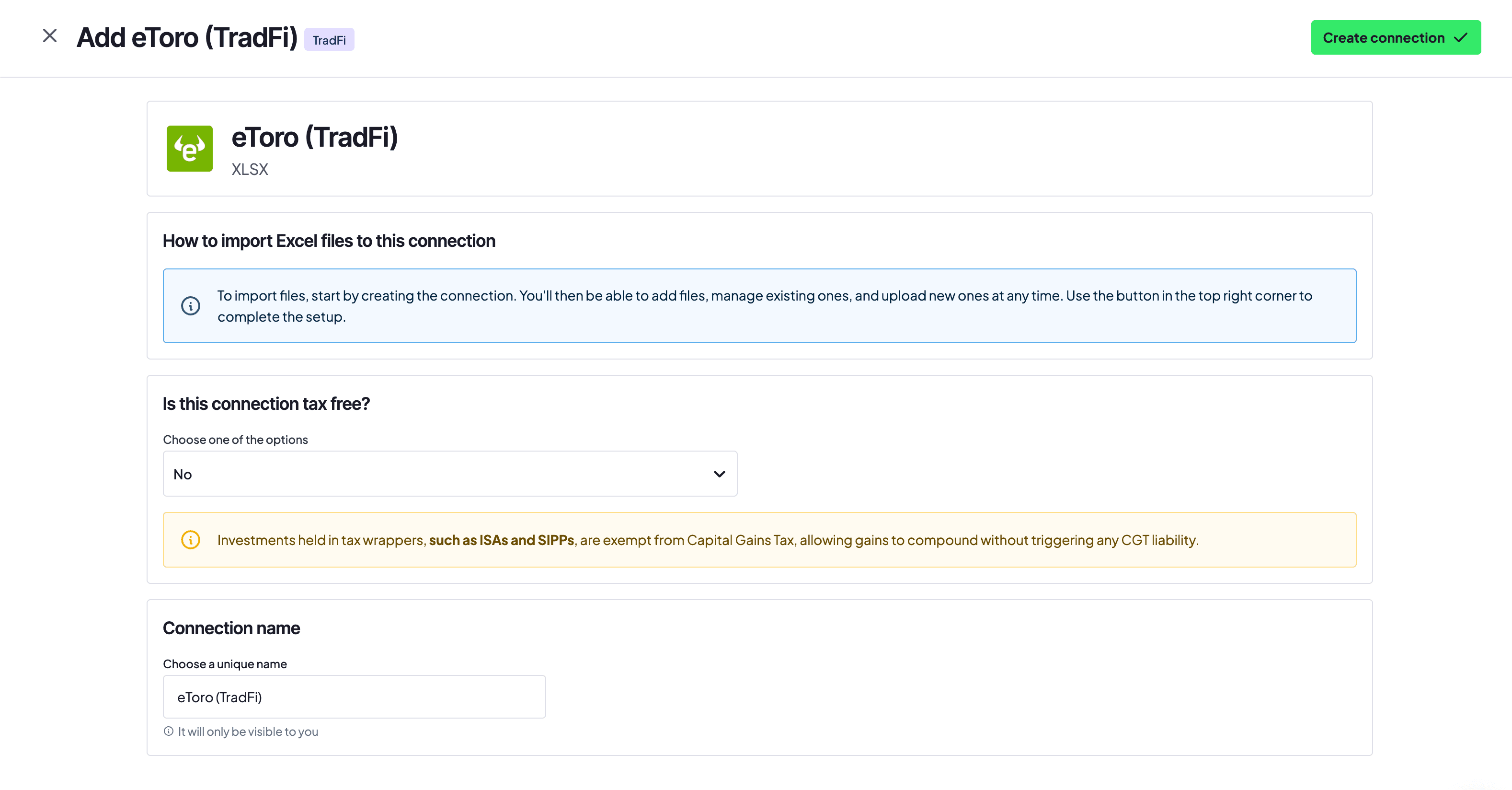
Finbooks reads the positions in the Account Statement, separates underlying assets from CFDs, converts the relevant amounts into pounds and applies the UK tax treatment to stocks, cryptoassets and income. The resulting figures are carried into your pre-filled Self Assessment.
If you transferred cryptoassets from eToro to a wallet and later sold or exchanged them elsewhere, the eToro statement covers only the eToro part of that history. Add the destination wallet or platform to Finbooks as well so that the crypto pool remains complete.
When is eToro tax due for 2025/26?
The 2025/26 tax year ran from 6 April 2025 to 5 April 2026. The online Self Assessment return and any outstanding tax are normally due by 31 January 2027.
If you need to file for the first time, you generally need to tell HMRC by 5 October 2026. A paper return is normally due by 31 October 2026. Payments on account may also apply to some Income Tax liabilities, with instalments due on 31 January and 31 July.
The eToro Account Statement can be generated before the filing deadline. Downloading the full history early leaves time to identify transferred crypto, missing acquisition costs and copied positions that were CFDs rather than holdings in the underlying assets.
What information does eToro report to HMRC?
eToro (UK) Ltd reports specified account and customer information to HMRC under the Common Reporting Standard. eToro explains that CRS figures are not the same as the amounts that belong on a UK tax return: CRS reporting can include realised profits without deducting positions closed at a loss.
Crypto reporting adds a separate layer. UK Cryptoasset Reporting Framework rules took effect on 1 January 2026. In-scope cryptoasset service providers must collect user and transaction data for the 2026 calendar year, with the first reports due to HMRC by 31 May 2027.
CARF applies to activity involving underlying cryptoassets, not to a CFD merely because it tracks a crypto price. HMRC can therefore receive platform data organised under a different framework from your Self Assessment calculation. Your return still needs to distinguish cryptoassets you own from crypto CFDs and apply the correct sterling values, costs and matching rules.
Keep the Excel statement and the calculation supporting your return. A platform report can show that activity occurred, but it does not explain acquisitions held elsewhere or determine the correct tax treatment of every position.
Report eToro with Finbooks
eToro brings several ways to invest into one account, but UK tax still follows each underlying position. A single portfolio can contain share disposals, foreign dividends, crypto pools, staking income and CFD results, all of which belong in different parts of the calculation.
Finbooks turns the eToro Account Statement into one consistent UK tax record. It identifies the activity behind the portfolio total, converts transactions into pounds, applies HMRC's pooling and matching rules and keeps capital gains separate from income before preparing the figures for Self Assessment.
The calculation becomes more valuable when eToro is only one part of your portfolio. A bitcoin disposal on eToro can depend on bitcoin bought through another exchange, while the allowable cost of a share can be affected by acquisitions through another broker. Finbooks brings those records together instead of treating each platform as a separate tax position.
You can review the imported history, resolve missing data and move from the eToro statement to a pre-filled Self Assessment without rebuilding every copied or manually opened trade in a spreadsheet.
Try Finbooks free for 7 days and turn your eToro history into Self Assessment-ready figures.