

DEGIRO is an execution-only broker built for self-directed investors. It provides access to shares, ETFs, funds, bonds and, for some legacy account profiles, options and futures across more than 45 markets. The platform does not settle a UK customer's tax liability with HMRC.
The DEGIRO brand sits within flatexDEGIRO Bank SE, a licensed German bank. UK accounts are provided through flatexDEGIRO Bank Dutch Branch, which is registered and supervised in the Netherlands while the parent bank is primarily supervised by Germany's BaFin. This is different from opening an investment account with a UK bank or FCA-authorised stockbroker.
The tax position is also different from using a UK Stocks & Shares ISA. DEGIRO does not currently offer an ISA through its UK service, so the account is taxable even if it is opened from the UK website, funded in pounds and used only for long-term investing.
DEGIRO gives investors an Annual Report and several downloadable account records. Those documents can help with tax preparation, but they do not apply the UK tax year, HMRC's share-matching rules or pooling across other brokers. This guide explains what needs reporting, which DEGIRO export Finbooks requires and how to turn that history into Self Assessment-ready figures.
What you need to know for 2025/26
DEGIRO does not currently offer a UK Stocks & Shares ISA, so gains and income in the standard account must be reviewed under the normal UK tax rules.
The Annual Report follows the calendar year, not the UK tax year, and cannot apply HMRC matching across DEGIRO and your other brokers.
Shares, ETFs, dividends, interest, bonds and legacy derivatives can follow different tax routes and should not be combined into one profit figure.
For Finbooks, download the Account Statement in CSV format for the complete available history; keep the Annual Report as a cross-check.
Do you need to report DEGIRO to HMRC?
DEGIRO activity may need to be reported when a UK tax resident sells or otherwise disposes of an investment, receives dividends or interest, or wants to claim an allowable capital loss.
Selling shares, ETFs, funds, bonds or derivatives can create a capital gain or loss. Dividends, bond coupons and cash interest are income rather than capital gains, so they follow separate allowances and sections of Self Assessment.
Buying an investment and continuing to hold it does not normally trigger a reportable disposal. Tax reporting usually becomes relevant when ownership changes, income is credited or a loss needs to be registered for use against gains.
For 2025/26, the Capital Gains Tax annual exempt amount for individuals is £3,000. The SA108 capital gains pages may still be required when no tax is due if you are already required to file Self Assessment and your total disposal proceeds for the year exceeded £50,000.
DEGIRO does not deduct UK Capital Gains Tax or complete Self Assessment on the investor's behalf. Foreign withholding may appear on dividends, and transaction taxes may be charged on certain purchases, but neither means that the resulting UK liability has been settled.
Does DEGIRO offer a Stocks & Shares ISA?
DEGIRO does not currently offer a UK Stocks & Shares ISA. The standard DEGIRO investment account sits outside an ISA wrapper, so its gains, losses, dividends and interest must be considered under the normal UK tax rules.
The absence of an ISA matters even for a passive portfolio. Reinvesting dividends does not make the income tax-free, and leaving sale proceeds inside DEGIRO does not defer a disposal. UK tax looks at what happened to the investment, not whether cash was withdrawn to a bank account.
The annual ISA subscription limit for 2025/26 is £20,000 across all ISAs, but that allowance cannot be applied retrospectively to investments held in DEGIRO. Selling an asset in DEGIRO and repurchasing it inside an ISA normally creates a disposal in the DEGIRO account, which may produce a gain or loss.
If the same shares are sold through DEGIRO and acquired inside an ISA within 30 days, the ISA purchase is not normally included in the seller's Section 104 pool because the ISA holder is treated separately for these purposes. The original DEGIRO sale remains a disposal and still needs its own calculation.
How DEGIRO is regulated and protected
DEGIRO is the trading name of flatexDEGIRO Bank Dutch Branch, the Dutch branch of flatexDEGIRO Bank SE. The parent is a licensed German bank primarily supervised by BaFin, while the Dutch branch is registered with De Nederlandsche Bank and supervised in the Netherlands by DNB and the Authority for the Financial Markets.
DEGIRO’s UK financial promotions are approved by WealthKernel Limited, but that does not make flatexDEGIRO Bank SE an FCA-authorised broker. DEGIRO states that UK investors are not protected by the Financial Services Compensation Scheme.
Investment and cash protection are separate
Segregated investments that cannot be returned may be covered by the German Investor Compensation Scheme for 90% of the loss, up to €20,000, while eligible deposits in a flatexDEGIRO Cash Account may be protected up to €100,000 under the German Deposit Guarantee Scheme. Legacy money-market-fund balances are investments, not protected bank deposits.
These arrangements do not cover market losses and do not change the tax treatment of the account.
How are DEGIRO investments taxed in the UK?
The tax treatment of a DEGIRO return depends on the instrument and the event that produced it. A DEGIRO account can contain capital disposals, dividend income, savings income and costs that belong in different parts of the tax calculation. Separating the activity by instrument and event gives you the right starting point.
| DEGIRO activity | What matters for UK tax | Where it is usually reported |
|---|---|---|
| Share disposals | Capital gain or allowable loss calculated in GBP after HMRC pooling and matching. | SA108 where reporting is required. |
| ETF and fund disposals | Capital treatment can depend on UK reporting-fund status; a non-reporting offshore fund can produce an offshore income gain. | SA108 or the relevant income pages, depending on fund status. |
| UK dividends | Dividend income, including amounts reinvested or retained in the account. | The dividends section of SA100. |
| Foreign dividends | Normally declared gross before overseas withholding tax, with Foreign Tax Credit Relief considered separately. | Usually SA106. |
| Bond coupons and cash interest | Savings or foreign income rather than capital gains; the source and instrument determine the precise route. | SA100 or SA106, as applicable. |
| Options, futures and short positions | Treatment depends on the contract, how the position ended and whether the activity is investment or trade. | Commonly SA108 for ordinary investing, or the relevant income pages where another treatment applies. |
These are the usual routes, not a substitute for checking the exact instrument. A single account statement may contain several types of taxable activity that cannot be netted against one another.
Shares, ETFs and HMRC matching
HMRC does not necessarily match a DEGIRO sale with the purchase shown beside it. Shares of the same class are matched first with acquisitions made on the same day, followed by acquisitions during the next 30 days; the remaining quantity is matched with the average cost in the Section 104 pool.
That pool applies across every taxable account you own. A sale on DEGIRO can therefore depend on shares bought through Interactive Brokers, Trading 212, Revolut or another platform, even though DEGIRO cannot include those acquisitions in its own cost basis.
Dealing commission and certain transaction costs can form part of the allowable cost. For UK shares, the 0.5% Stamp Duty Reserve Tax charged on some purchases can be relevant to the capital gains calculation rather than treated as a separate income deduction.
Dividends and foreign withholding tax
Dividends are income even when they are automatically reinvested or remain in the DEGIRO cash balance. UK dividends normally go in the dividends section of SA100, while overseas dividends normally belong on SA106.
The account statement may show both a dividend and foreign tax withheld. A UK return generally starts from the gross dividend before withholding, with any available Foreign Tax Credit Relief considered separately. The cash received after tax is not the amount to use automatically as taxable dividend income.
For 2025/26, the dividend allowance is £500. Dividends above the available allowance are taxed at 8.75% within the basic-rate band, 33.75% within the higher-rate band and 39.35% within the additional-rate band.
Bonds, funds and cash interest
Bond coupons and interest credited on cash are generally savings income. Foreign interest normally belongs on SA106, while UK interest can be reported through the relevant section of SA100.
The Personal Savings Allowance for 2025/26 is normally £1,000 for basic-rate taxpayers, £500 for higher-rate taxpayers and nil for additional-rate taxpayers. The allowance affects how much interest is taxed, but the income still needs to be identified separately from gains.
Selling or redeeming a bond may create a capital gain or loss, although accrued income rules and the legal terms of the security can change the result. Investment funds also need to be classified by their structure rather than treated automatically like ordinary shares.
Options, futures and short positions
Options and futures are available only to certain legacy DEGIRO accounts, while short selling depends on the account profile and product. Their treatment follows the contract and how the position was closed, exercised, expired or settled.
Do not collapse every derivative into one profit figure
Many individuals investing on their own account fall within Capital Gains Tax, while activity that genuinely amounts to a financial trade may be subject to Income Tax. Short positions can also create manufactured payments that should not automatically be treated like ordinary dividends.
Offshore ETFs and reporting fund status
An offshore ETF's UK reporting fund status can change the tax result. A gain on a non-reporting offshore fund may be taxed as income instead of as a capital gain. A reporting fund can produce excess reportable income even when the investor receives no cash distribution.
Check the exact fund and share class against HMRC's reporting funds list. An ETF being available to UK customers on DEGIRO does not prove that it has UK reporting fund status.
Can you use the DEGIRO Annual Report for Self Assessment?
The DEGIRO Annual Report is helpful, but it cannot be copied straight into a UK Self Assessment. It was designed as an account summary, not as a calculation built around HMRC's tax year and share-matching rules.
The dates are the most immediate problem. DEGIRO reports from 1 January to 31 December, whereas the 2025/26 UK tax year runs from 6 April 2025 to 5 April 2026. The 2025 Annual Report therefore straddles two UK tax years: its first three months belong to 2024/25, while the first three months of 2026 are missing altogether.
A calendar-year report does not cover the UK tax year
The 2026 Annual Report includes 1 January to 5 April 2026, which belongs to 2025/26, and excludes 1 January to 5 April 2027, which belongs to 2026/27.
The figures also come with an important limitation. DEGIRO describes the Annual Report as informative and prepared on a best-effort basis because the platform serves customers in several countries. It is not guaranteed to follow every part of UK tax law, and DEGIRO says that the document cannot be amended after it has been issued.
Even a perfectly accurate summary of the DEGIRO account would still know nothing about the same shares held with another broker. Those outside purchases can change the cost matched to a DEGIRO sale under HMRC's same-day, 30-day and Section 104 rules.
The Annual Report still earns its place in your records: it is a useful sense-check for holdings, dividends and withholding tax. The calculation itself, however, needs to start from the dated account activity covering the correct UK tax year and any earlier purchases that remain in the pool.
Why is DEGIRO's profit different from your taxable gain?
DEGIRO's profit figure answers a portfolio question: how did the position perform inside this account? HMRC asks a different question: what gain or loss arose in pounds after applying UK rules across all your taxable holdings of the asset?
Currency conversion is one reason the answers diverge. A US share bought for dollars and later sold for dollars needs a sterling acquisition cost on the purchase date and sterling proceeds on the sale date. Converting the final dollar profit only once can miss the effect of exchange-rate movements between those dates. AutoFX records the currency conversion inside DEGIRO, but it does not replace that transaction-by-transaction UK calculation.
The platform's cost basis can then be displaced by HMRC's matching rules. A sale shown against an older DEGIRO purchase may instead match with shares acquired on the same day or during the following 30 days, including purchases made through another taxable account. Moving shares between accounts owned by the same person does not normally create a fresh cost either.
The account's overall return also mixes amounts that UK tax keeps apart. A capital loss cannot be set against dividends or interest, while dealing fees, Stamp Duty Reserve Tax, foreign withholding and corporate actions each need to be attached to the transaction or income stream they relate to.
There may also be a separate question around foreign currency left in the account rather than spent immediately on an investment. Currency other than sterling is generally an asset for Capital Gains Tax purposes, although the treatment and available exemptions depend on how the balance is held and used.
Once those adjustments have been made, gains above the available £3,000 annual exempt amount for 2025/26 are normally taxed at 18% within the unused basic-rate band and 24% above it.
What DEGIRO file do you need for Finbooks?
For Finbooks, you only need the DEGIRO Account Statement in CSV format. It contains the dated account activity behind your purchases, sales, dividends, withholding tax, fees and currency conversions, so there is no need to assemble a folder of screenshots and separate PDF summaries.
The similarly named Transaction Statement may sound like the obvious export, but it is limited to investments bought and sold. The Account Statement gives the more complete record because it also includes dividends and the cash entries connected with those trades.
For the first import, set the start date as far back as DEGIRO allows rather than beginning on 6 April 2025. A disposal in 2025/26 may still depend on shares bought several years earlier, and leaving out that purchase would leave the Section 104 pool without its original cost. Where one CSV cannot cover the entire period, consecutive files are fine as long as there are no gaps between them.
Keep the PDF Annual Report alongside your records as a reconciliation document, but upload the CSV Account Statement to Finbooks.
How to import DEGIRO into Finbooks
- 1
Log in to the DEGIRO platform;
- 2
open Inbox from the menu;
- 3
select Account Statement;
- 4
change the start and end dates, to cover the complete available account history;
- 5
select the export icon and choose CSV;
- 6
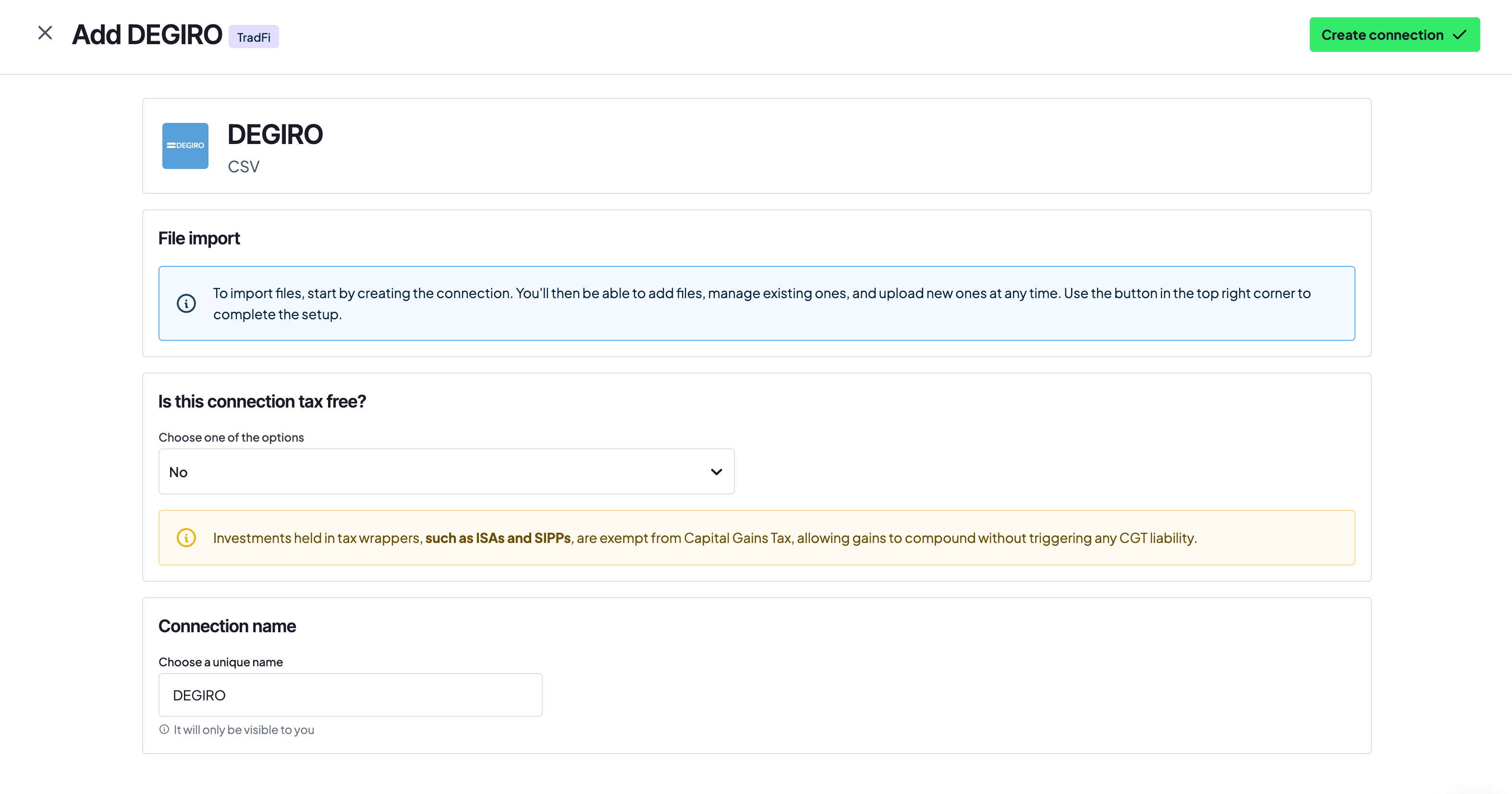
upload the file to Finbooks by creating a DEGIRO connection or updating an existing one.
DEGIRO defaults to a single month, so check the range before generating the export. In the app, the same report is available through Inbox, where the export control appears as a downward arrow.
Once uploaded, Finbooks rebuilds the investment history, converts relevant amounts into pounds, separates dividends and interest from capital gains and applies HMRC’s matching rules before preparing the figures for your pre-filled Self Assessment.
When is DEGIRO tax due for 2025/26?
The 2025/26 tax year ran from 6 April 2025 to 5 April 2026. The online Self Assessment return and any outstanding tax are normally due by 31 January 2027.
If you need to file for the first time, you generally need to tell HMRC by 5 October 2026. A paper return is normally due by 31 October 2026. Payments on account may also apply to some Income Tax liabilities, with instalments due on 31 January and 31 July.
There is no reason to wait for DEGIRO's annual PDF before starting. The Account Statement can be exported for a custom period as soon as the tax year has ended, leaving time to find older acquisition costs and check purchases held with other brokers before the January deadline.
DEGIRO and HMRC compliance checks
DEGIRO collects each customer's tax residence and reports account information to the Dutch tax authority under the Common Reporting Standard. That information can include the customer's identity and tax number, year-end balance, gross interest and dividends, and gross sale proceeds. For a UK resident, the Dutch authority can pass the data to HMRC.
Gross proceeds are not the same as a taxable gain: they show how much was received from sales before deducting purchase costs and applying matching rules. They do, however, give HMRC a figure against which the disposals on a Self Assessment return can be compared.
That is where apparently small shortcuts become visible. A return based on the 2025 calendar-year total will omit January to 5 April 2026 and include three months from the wrong tax year. Dividends entered net of foreign withholding will not match the gross income record, and DEGIRO's cost basis may conflict with acquisitions reported by another broker.
Keep the original CSVs and Annual Reports together with evidence for transfers and corporate actions. If HMRC ever asks how a figure was produced, the calculation should lead back to the dated transaction, the sterling value used and the section of the return in which it was reported.
Report DEGIRO with Finbooks
DEGIRO gives you a detailed record of the account, but the record stops where the UK tax calculation begins. Its Annual Report follows the calendar year, its performance screen looks only at DEGIRO, and neither can see the matching purchases you may have made on another platform.
Finbooks brings those pieces into the same tax history. The DEGIRO CSV is converted into sterling transaction by transaction, dividends and interest remain separate from capital gains, and HMRC's pooling rules are applied across the investments you have imported from every platform.
You are left with a calculation that follows the UK tax year and can be traced back to the underlying trades, rather than a collection of broker totals that each tell only part of the story. From there, you can review any missing costs or transfers and generate a pre-filled Self Assessment without rebuilding the account line by line in a spreadsheet.
Try Finbooks free for 7 days and turn your DEGIRO history into Self Assessment-ready figures.
DEGIRO UK tax questions
No. It follows the calendar year and does not apply HMRC’s matching rules or account for holdings with other brokers.
No. The standard DEGIRO account is taxable, so relevant gains, losses and income must be considered under the normal UK rules.
Download the Account Statement in CSV format for the complete available history. Keep the Annual Report as a reconciliation document.