

Bitpanda is a European crypto broker founded in Vienna. Its global platform has offered both digital and traditional investments, but that description needs qualifying for a UK tax guide: British residents are now served through a dedicated crypto platform operated by Bitpanda Broker UK Ltd, where the core products are spot cryptoassets, staking, savings plans and automatically rebalanced Crypto Indices.
That range creates several kinds of tax event inside an interface that presents them as one portfolio. A bitcoin purchase is normally just an acquisition; a bitcoin-to-ether swap is a disposal; a weekly staking credit can be income; and a Crypto Index may sell and replace tokens during its monthly rebalance without asking you to place each trade. UK customers who held assets before the move to the new platform may also have transactions split across different Bitpanda entities and product ranges during the same tax year.
This guide explains what Bitpanda activity needs reporting, how the UK migration affects your records, which transaction file to download and how to import it into Finbooks to calculate your tax-ready figures and prepare a pre-filled Self Assessment.
Do you need to report Bitpanda to HMRC?
You may need to report Bitpanda if you disposed of cryptoassets, received staking or other rewards, realised activity in a discontinued product or need to claim a capital loss.
For cryptoassets, a disposal is wider than a cash withdrawal. Selling a token for pounds is a disposal, but so is exchanging it for another token, using it to pay for something or giving it to anyone other than your spouse or civil partner. Moving the same beneficially owned asset between your own Bitpanda account and personal wallet is not normally a disposal, although the fee paid to complete the transfer may still need attention.
Buying crypto with pounds and continuing to hold it is not normally reportable by itself. Regular purchases made through a Bitpanda Savings Plan follow the same principle: each execution adds an acquisition to the relevant token's cost record, while the tax event usually arrives when those tokens are later sold, swapped, spent or given away.
For 2025/26, individuals generally have a £3,000 Capital Gains Tax annual exempt amount. Gains above the available amount are normally taxed at 18% to the extent they fall within the unused basic-rate band and at 24% above it. If you are already required to submit Self Assessment, the capital gains pages may still be needed when total proceeds from chargeable disposals exceeded £50,000, even if your net gain remained below £3,000.
The allowance and £50,000 proceeds test apply across your chargeable disposals, not to Bitpanda in isolation. For the 2025/26 return, crypto gains and losses are brought together in the dedicated cryptoassets section of SA108, while staking rewards and other taxable receipts remain income and go through the relevant income part of the return.
Staking rewards sit outside that capital-gains test when they first arrive. For an individual whose activity does not amount to a trade, HMRC commonly treats them as miscellaneous income at their sterling value on receipt. The £1,000 trading and miscellaneous income allowance may be available against eligible income from all relevant sources, subject to its conditions; it is not a separate £1,000 allowance for each platform.
What changed when Bitpanda moved UK customers to its UK platform?
During the period relevant to the 2025/26 return, Bitpanda began moving British residents to a dedicated platform operated by Bitpanda Broker UK Ltd. Customers were asked to accept new terms, verify their UK identity and address, complete a mandatory 24-hour cooling-off period and pass an appropriateness assessment.
The change was more than an administrative rebrand: stocks and ETFs, commodities and precious metals, Bitpanda Cash Plus, several fiat currencies and certain cryptoassets were not supported on the UK platform. Existing savings plans were stopped during the transition, although customers could create new crypto savings plans after moving. Bitpanda allowed unsupported holdings to be sold or swapped before 1 February 2026, whether or not the customer completed the migration.
For tax, the migration itself should not be treated as a disposal merely because the provider or account environment changed. What matters is what happened to each asset. If the same cryptoasset remained beneficially yours throughout a transfer of records, there may be no disposal; if an unsupported token was sold for cash or exchanged for a supported token, that transaction is a disposal under the ordinary rules. A platform-imposed deadline does not create a special Capital Gains Tax exemption.
The timing also means that one 2025/26 history can contain activity under Bitpanda GmbH before the move and Bitpanda Broker UK Ltd afterwards. Anyone who previously used products no longer offered in the UK should retain the pre-migration statements as well as the new-platform export. The current UK product menu cannot tell you what was held or realised earlier in the tax year.
Historical Bitpanda Stocks also need careful classification. Bitpanda described those products as contracts replicating an underlying share or ETF rather than ordinary direct ownership of the security. A position carrying a familiar share ticker should therefore not be dropped into a share pool without checking the product terms and transaction record. The same principle applies to any historical metals or Cash Plus activity: the tax treatment follows the legal product you held, not the label shown beside its market price.
Is Bitpanda FCA regulated and FSCS protected?
Bitpanda Broker UK Ltd is registered with the Financial Conduct Authority under firm reference number 925234 as a cryptoasset business. That registration concerns compliance with the UK's anti-money laundering and counter-terrorist financing regime; it is not the same as full FCA authorisation for regulated investments.
Bitpanda's legal notice states that neither the Financial Ombudsman Service nor the Financial Services Compensation Scheme applies to its UK cryptoasset services. Bitpanda says that it holds customers' underlying cryptoassets as trustee and records beneficial ownership through its internal platform ledger, but those custody arrangements do not create FSCS cover.
This distinction is easy to blur because registration, custody and tax answer different questions. FCA registration describes regulatory supervision, custody terms describe the rights attached to the assets and HMRC rules determine whether a sale, swap or reward is taxable. None of the three protects you from market losses.
FCA registration does not make Bitpanda crypto tax-free or FSCS-protected. It confirms AML and CFT supervision of the UK cryptoasset business, while your gains and income remain subject to the ordinary UK tax rules.

You invest. We handle the tax.

How is Bitpanda crypto taxed in the UK?
The tax treatment follows the transaction that took place, so the cleanest way through a Bitpanda history is to separate acquisitions, disposals and income before calculating the result.
Buying, selling and swapping crypto
Buying a cryptoasset with pounds establishes an acquisition cost. That cost, together with eligible transaction fees, contributes to the Section 104 pool for that type of token.
Selling the token for fiat creates a disposal. Bitpanda's swap function creates one as well: exchanging bitcoin for ether is treated as a disposal of bitcoin at its sterling market value and an acquisition of ether for the corresponding sterling amount. The fact that no pounds reached your bank account does not defer the gain.
Stablecoins are cryptoassets for this purpose. Moving from bitcoin into USDC or another stablecoin is not the tax equivalent of keeping cash inside the account; it normally crystallises a disposal of the bitcoin, and the stablecoin begins its own cost record.
Section 104 pools and transactions elsewhere
HMRC does not calculate the gain by subtracting the price of the particular coin you remember buying. Fungible tokens of the same type are generally grouped in a Section 104 pool, with same-day acquisitions matched first and acquisitions made within the following 30 days matched next.
The pool belongs to you, not to Bitpanda. Bitcoin bought through another exchange or wallet can affect the allowable cost of bitcoin sold on Bitpanda, while a transfer from Bitpanda to self-custody carries its existing acquisition history with it. A platform-only profit figure cannot apply those rules because it cannot see the rest of your holdings.
Bitpanda Staking rewards
Bitpanda distributes staking rewards weekly and normally restakes them automatically. Each reward is commonly taxable as miscellaneous income at its sterling value when it becomes yours, unless the scale and organisation of the activity genuinely amount to a trade.
That sterling value also becomes an acquisition cost for the rewarded tokens. If you later sell or swap them, the disposal enters the relevant token pool and can produce a capital gain or loss. Auto-staking therefore creates a succession of small income receipts and acquisitions rather than one taxable event when the entire position is eventually sold.
The amount credited after Bitpanda's commission is the natural starting point, but your history still needs to preserve the reward date, token quantity and sterling value. Looking only at the final staked balance loses the information needed to distinguish taxable income from later capital growth.
Bitpanda Crypto Indices and monthly rebalancing
A Bitpanda Crypto Index gives you exposure to a basket of cryptoassets whose composition and weightings are reviewed automatically. The portfolio is rebalanced through buys and sells, generally each month, as tokens enter, leave or change weight within the index.
That convenience has an important UK tax consequence: every underlying token sold during a rebalance can be a disposal, even though Bitpanda initiated it automatically and you kept the Index investment open. New tokens acquired during the same process enter their own pools, while trading premiums form part of the transaction-level calculation where allowable.
Bitpanda's help material notes that automatic rebalancing receives favourable crypto-to-crypto treatment in Austria. A UK resident cannot import that Austrian result into Self Assessment. Under HMRC's rules for 2025/26, exchanging one cryptoasset for another is normally a disposal, so the rebalance must be reconstructed from the underlying trades rather than treated as a tax-free change to a single fund unit.
Selling part of a Crypto Index can generate several disposals at once because Bitpanda sells the component assets proportionately. The amount credited to your fiat wallet is therefore not one gain to compare with one original purchase; the proceeds and allowable costs need allocating across the cryptoassets that were actually disposed of.
Savings Plans and transfers to your own wallet
A Bitpanda Savings Plan automates purchases at a chosen frequency. The executions are normally acquisitions rather than income or disposals, but each one changes the quantity and pooled cost of the relevant token. Downloading only the year in which you sold can miss purchases made by an older savings plan and overstate the gain.
Sending crypto from Bitpanda to a wallet that you beneficially own does not normally dispose of the asset. Finbooks still needs both sides of the movement so the withdrawal is matched to the deposit instead of being mistaken for a sale or an unexplained receipt. If the destination wallet later swaps, spends or sells the tokens, that later transaction completes the tax history.
Why is Bitpanda's portfolio result different from your taxable gain?
Bitpanda measures performance within its own platform, whereas a UK tax calculation has to identify every disposal, apply HMRC's matching rules and express both costs and proceeds in pounds.
The difference is particularly visible with Crypto Indices. The headline Index performance can remain positive while monthly rebalances have already produced a series of gains and losses in the underlying tokens. Staking creates another split: the reward is income when received, while subsequent price movement belongs to the capital calculation. Combining those amounts into one portfolio return would put different tax categories through the same arithmetic.
Currency adds a further layer to pre-migration records. Older Bitpanda activity may be denominated in euros or another currency even though the UK calculation must be made in sterling. Acquisition costs, rewards and disposal proceeds need converting at the relevant transaction dates; converting the final annual total at one exchange rate can produce the wrong gain.
Finally, Bitpanda cannot account for the same cryptoassets held elsewhere. A bitcoin sale on the platform may be matched with bitcoin acquired through another exchange within the following 30 days, and losses realised outside Bitpanda may reduce gains inside it. The correct result emerges only after the underlying history has been combined across platforms and wallets.
What Bitpanda file do you need for Finbooks?
Download the complete Bitpanda transaction history in CSV format. It contains the buys, sells, swaps, deposits, withdrawals, rewards, fees and fiat movements needed to rebuild the UK calculation.
UK customers should not look for Bitpanda's dedicated tax report. That document is currently designed for Austrian tax residents and follows Austrian rules, while quarterly and yearly statements are account summaries rather than UK tax calculations. A PDF can help you reconcile balances, but the CSV provides the structured transaction-level data Finbooks needs.
Use your entire Bitpanda history for the first import, not only 6 April 2025 to 5 April 2026. A token sold during 2025/26 may have been acquired years earlier, and repeated Index rebalances or savings-plan purchases will have changed its pooled cost along the way.
The UK transition deserves one additional check. Compare the first and last dates in the CSV with your actual account history. If the export does not include activity held under the previous Bitpanda entity, add the pre-migration export or statements rather than assuming the new account begins the tax record from zero.
How to import Bitpanda into Finbooks
1. Log in to Bitpanda on the web.
2. Open your profile and select Reports and Statements.
3. Choose Transaction history.
4. Set the period from your first Bitpanda transaction through to the present.
5. Select CSV as the file format and download the export.
6. Upload the CSV to Finbooks by creating a Bitpanda connection or updating your existing one.
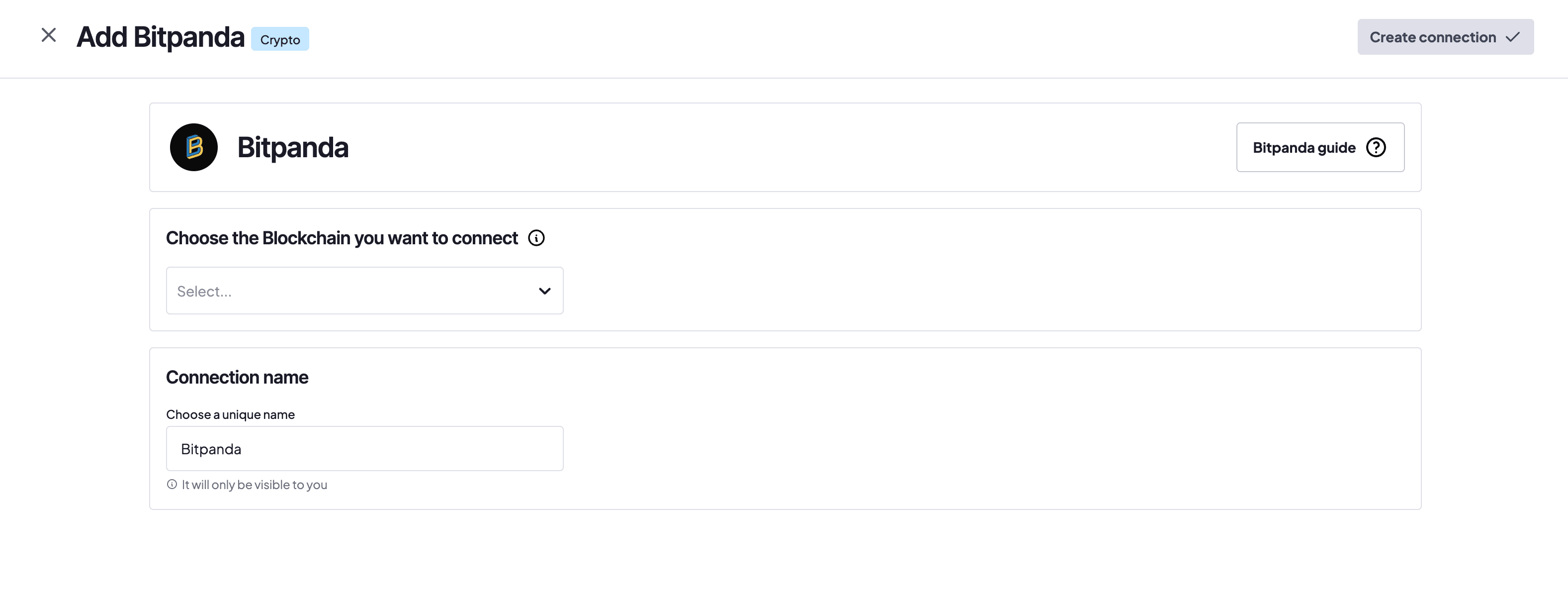
Once the CSV is imported, Finbooks reconstructs the tax position beneath the portfolio total. The relevant values are converted into pounds, the Section 104 pools are maintained across the imported history, staking income is kept apart from capital disposals and the trades created by Index rebalancing are carried into the Self Assessment calculation.
If you sent crypto to another exchange or personal wallet, connect or import that destination as well. The Bitpanda withdrawal proves that assets left the platform, but the receiving history is what shows whether you continued to hold them or later made a taxable disposal.
When is Bitpanda tax due for 2025/26?
The 2025/26 UK tax year ran from 6 April 2025 to 5 April 2026. Your online Self Assessment return and any tax due are normally payable by 31 January 2027.
If this is the first year for which you need to file, you generally need to notify HMRC by 5 October 2026. Paper returns are normally due by 31 October 2026. Some taxpayers also make payments on account towards Income Tax liabilities, with instalments falling on 31 January and 31 July.
Bitpanda's account migration and 1 February 2026 unsupported-asset deadline both fell inside 2025/26. Downloading the history early gives you time to identify forced sales or swaps, recover earlier acquisition costs and confirm that records from both sides of the migration are present before the filing deadline.
What information can Bitpanda report to HMRC?
The UK's Cryptoasset Reporting Framework took effect on 1 January 2026. In-scope cryptoasset service providers must begin collecting due-diligence and transaction information from that date, with the first reports for the 2026 calendar year due to HMRC by 31 May 2027.
The reporting period does not match the UK tax year: the first CARF period covers 1 January to 31 December 2026, while the 2025/26 Self Assessment covers 6 April 2025 to 5 April 2026. Platform reporting can help HMRC identify customers and activity, but it does not calculate the gain that belongs on your return or apply losses, allowances and token pools held elsewhere.
Keep the CSV, any pre-migration statements and the calculation supporting your figures. HMRC may receive evidence that a sale or swap occurred; your records need to show how its sterling proceeds and allowable cost were established.
Report Bitpanda with Finbooks
Bitpanda makes it possible to buy, stake and diversify across cryptoassets without managing every action manually. UK tax still follows the transactions underneath that experience, including the weekly rewards and automatic rebalances that can accumulate long before you withdraw any cash.
Finbooks follows each token through Bitpanda and the rest of your portfolio, so the history behind the account balance can be restated under HMRC rules without losing the allowable costs, losses or income distinctions that determine the final liability. The relevant figures are then prepared for Self Assessment as one reviewable UK tax position.
That means you can review the calculation behind the return rather than trying to convert Bitpanda's portfolio performance into a tax number it was never designed to provide.
Try Finbooks free for 7 days and turn your Bitpanda history into Self Assessment-ready figures.